


Tested & Approved JN0-335 Study Materials Download Free Updated 100 Questions
Regular Free Updates JN0-335 Dumps Real Exam Questions Test Engine
Juniper JN0-335 (Security, Specialist (JNCIS-SEC)) Certification Exam is a professional-level certification program offered by Juniper Networks, a leading provider of networking equipment and solutions. Security, Specialist (JNCIS-SEC) certification is designed to validate the skills and knowledge of individuals who have experience in security technologies and want to advance their career in the field of network security.
NEW QUESTION # 55
Click the Exhibit button.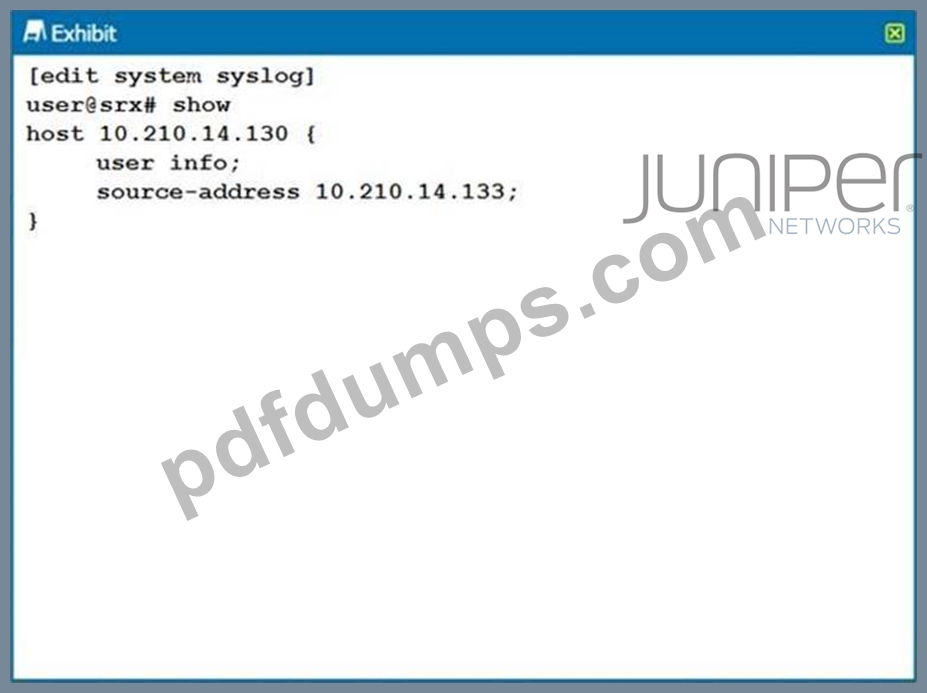
Referring to the configuration shown in the exhibit, which two statements are true? (Choose two.)
- A. The log is being stored on the local Routing Engine.
- B. The log is being sent to a remote server.
- C. The syslog is configured for an info facility.
- D. The syslog is configured for a user facility.
Answer: B,D
NEW QUESTION # 56
Which method does the loT Security feature use to identify traffic sourced from IoT devices?
- A. The SRX Series device identifies loT devices using their MAC address.
- B. The SRX Series device identifies loT devices from metadata extracted from their transit traffic.
- C. The SRX Series device streams transit traffic received from the IoT device to Juniper ATP Cloud.
- D. The SRX Series device streams metadata from the loT device transit traffic to Juniper ATP Cloud Juniper ATP Cloud.
Answer: B
Explanation:
The metadata is used to identify the type of device, its associated activities and its threat profile. This information is used to determine the appropriate security policy for the device. For more information on loT Security, please refer to the Juniper Security, Specialist (JNCIS-SEC) study guide.
NEW QUESTION # 57
You are asked to implement IPS on your SRX Series device.
In this scenario, which two tasks must be completed before a configuration will work? (Choose two.)
- A. Download the IPS signature database.
- B. Reboot the SRX Series device.
- C. Enroll the SRX Series device with Juniper ATP Cloud.
- D. Install the IPS signature database.
Answer: A,D
Explanation:
The two tasks that must be completed before a configuration for IPS on an SRX Series device will work are downloading the IPS signature database and installing the IPS signature database. The Security, Specialist (JNCIS-SEC) Study guide provides further information on how to download and install the IPS signature database. Enrolling the SRX Series device with Juniper ATP Cloud is not necessary to make a configuration work, and rebooting the SRX Series device is not required either.
NEW QUESTION # 58
When a security policy is deleted, which statement is correct about the default behavior of active sessions allowed by that policy?
- A. The active sessions allowed by the policy will be marked as a legacy flow and will continue to be forwarded.
- B. The active sessions allowed by the policy will be reevaluated by the cached
- C. The active sessions allowed by the policy will continue
- D. The active sessions allowed by the policy will be dropped.
Answer: D
Explanation:
When a security policy is deleted, the active sessions allowed by the policy will be dropped. The default behavior is that all active sessions allowed by the policy will be terminated and the traffic will no longer be forwarded. There is no way to mark the active sessions as a legacy flow or to reevaluate them by the cached rules.
Reference:
According to Juniper Networks Security, Specialist (JNCIS-SEC) Study Guide, when a security policy is deleted, the active sessions allowed by that policy will be dropped. This behavior is the default behavior of the device. There is no way to mark the active sessions as a legacy flow or to re-evaluate them against cached rules. The device will terminate the active sessions and will no longer forward traffic for those sessions.
NEW QUESTION # 59
Your manager asks you to provide firewall and NAT services in a private cloud. Which two solutions will fulfill the minimum requirements for this deployment? (Choose two.)
- A. a cSRX for firewall services and a separate cSRX for NAT services
- B. a single vSRX
- C. a vSRX for firewall services and a separate vSRX for NAT services
- D. a single cSRX
Answer: A,C
Explanation:
A single vSRX or cSRX cannot provide both firewall and NAT services simultaneously. To meet the minimum requirements for this deployment, you need to deploy a vSRX for firewall services and a separate vSRX for NAT services (option B), or a cSRX for firewall services and a separate cSRX for NAT services (option C).
NEW QUESTION # 60
Which two statements are correct about Juniper ATP Cloud? (Choose two.)
- A. Once the target threshold is met, Juniper ATP Cloud continues looking for threats levels range from 0 to 10 minutes.
- B. Once the target threshold is met, Juniper ATP Cloud continues looking for threats from 0 to 5 minutes.
- C. The threat levels range from 0-10.
- D. The threat levels range from 0-100.
Answer: B,C
Explanation:
According to the Juniper Networks JNCIS-SEC Study Guide, Juniper ATP Cloud sets target thresholds for security events and then continuously scans the environment for any activity that exceeds this threshold. Once the threshold is met, Juniper ATP Cloud continues looking for threats for a period of 0 to 5 minutes. The threat levels range from 0 to 10, with 0 being the lowest and 10 being the highest.
NEW QUESTION # 61
You are asked to determine how much traffic a popular gaming application is generating on your network.
Which action will you perform to accomplish this task?
- A. Enable AppQoS on the proper security zones
- B. Enable screen options on the proper security zones
- C. Enable AppTrack on the proper security zones.
- D. Enable APBR on the proper security zones
Answer: C
Explanation:
AppTrack is a feature of Juniper Networks firewall solutions that allows administrators to track applications, users, and the amount of traffic generated by those applications on the network.
AppTrack can be enabled on specific security zones of the network to monitor traffic on those zones. This feature can be used to determine how much traffic a popular gaming application is generating on the network.
AppTrack is a feature of the Junos OS that provides visibility into the applications and users on your network. It tracks the usage of applications and provides detailed reports on the amount of traffic generated by each application. By enabling AppTrack on the proper security zones, you can determine how much traffic a popular gaming application is generating on your network.
NEW QUESTION # 62
What is the default session timeout value for ICMP and UDP traffic?
- A. 30 minutes
- B. 5 minutes
- C. 60 seconds
- D. 30 seconds
Answer: C
NEW QUESTION # 63
Which three statements about SRX Series device chassis clusters are true? (Choose three.)
- A. Recovery from a control link failure requires that the secondary member device be rebooted.
- B. A control link failure causes the secondary cluster node to be disabled.
- C. Chassis cluster member devices synchronize configuration using the control link.
- D. Chassis cluster control links must be configured using RFC 1918 IP addresses.
- E. Heartbeat messages verify that the chassis cluster control link is working.
Answer: B,C,E
Explanation:
1. Chassis cluster member devices synchronize configuration using the control link: This statement is correct because the control link is used for configuration synchronization among other functions.
2. A control link failure causes the secondary cluster node to be disabled: This statement is correct because a control link failure causes the secondary node to become ineligible for primary role and remain in secondary role until the control link is restored.
3. Heartbeat messages verify that the chassis cluster control link is working: This statement is correct because heartbeat messages are sent periodically over the control link to monitor its status.
NEW QUESTION # 64
You are asked to block malicious applications regardless of the port number being used.
In this scenario, which two application security features should be used? (Choose two.)
- A. AppTrack
- B. AppFW
- C. APPID
- D. AppQoE
Answer: B,C
Explanation:
you can block applications and users based on network access policies, users and their job roles, time, and application signatures2. You can also use Juniper Advanced Threat Prevention (ATP) to find and block commodity and zero-day cyberthreats within files, IP traffic, and DNS requests1
NEW QUESTION # 65
Exhibit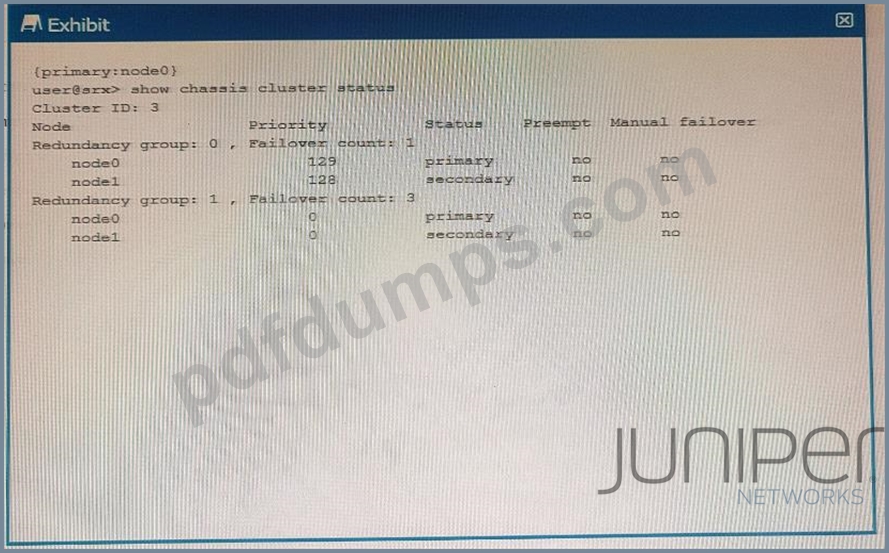
Using the information from the exhibit, which statement is correct?
- A. Redundancy group 0 is in an ineligible state.
- B. Node1 is the active node for the control plane
- C. There are no issues with the cluster.
- D. Redundancy group 1 is in an ineligible state.
Answer: D
NEW QUESTION # 66
Which two statements are correct about server-protection SSP proxy? (Choose two.)
- A. The server-protection SSL proxy is also known as SSL reverse proxy.
- B. The server-protection SSL proxy forwards the server certificate after modification.
- C. The server-protection SSL proxy acts as the server from the client's perspective.
- D. The server-protection SSL proxy intercepts the server certificate.
Answer: A,C
NEW QUESTION # 67
What is the default timeout for a TCP session on an SRX Series device?
- A. 1 minute
- B. 1 hour
- C. 30 minutes
- D. 30 seconds
Answer: C
NEW QUESTION # 68
You are experiencing excessive packet loss on one of your two WAN links route traffic from the degraded link to the working link Which AppSecure component would you use to accomplish this task?
- A. AppQoS
- B. AppFW
- C. AppQoE
- D. APBR
Answer: D
Explanation:
APBR (Application Path-Based Routing) is an AppSecure component which can be used to route traffic from the degraded link to the working link in order to reduce packet loss. APBR is a policy-based routing solution that allows you to configure rules to direct traffic to the most appropriate path, based on application, user, or network metrics.
NEW QUESTION # 69
What are two types of attack objects used by IPS on SRX Series devices? (Choose two.)
- A. protocol anomaly-based attacks
- B. DDoS-based attacks
- C. signature-based attacks
- D. spam-based attacks
Answer: A,C
NEW QUESTION # 70
Which solution enables you to create security policies that include user and group information?
- A. NETCONF
- B. JIMS
- C. Network Director
- D. ATP Appliance
Answer: B
Explanation:
The solution that enables you to create security policies that include user and group information is JIMS (Juniper Identity Management Service). JIMS collects and maintains a large database of user, device, and group information from Active Directory domains or syslog sources, and enables SRX Series devices to rapidly identify thousands of users in a large, distributed enterprise. With JIMS, you can create security policies that include user and group information, and enforce user-based access control policies to protect network resources.
NEW QUESTION # 71
Exhibit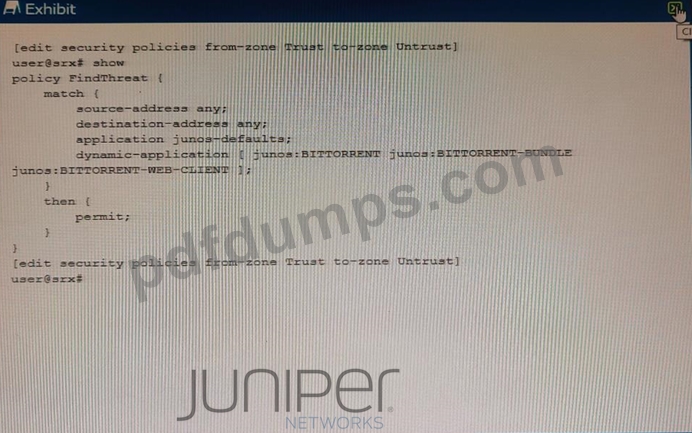
You are asked to track BitTorrent traffic on your network. You need to automatically add the workstations to the High_Risk_Workstations feed and the servers to the BitTorrent_Servers feed automatically to help mitigate future threats.
Which two commands would add this functionality to the FindThreat policy? (Choose two.)
- A.

- B.

- C.

- D.

Answer: B
NEW QUESTION # 72
You are asked to ensure that servers running the Ubuntu OS will not be able to update automatically by blocking their access at the SRX firewall. You have configured a unified security policy named Blockuburrtu, but it is not blocking the updates to the OS.
Referring to the exhibit which statement will block the Ubuntu OS updates?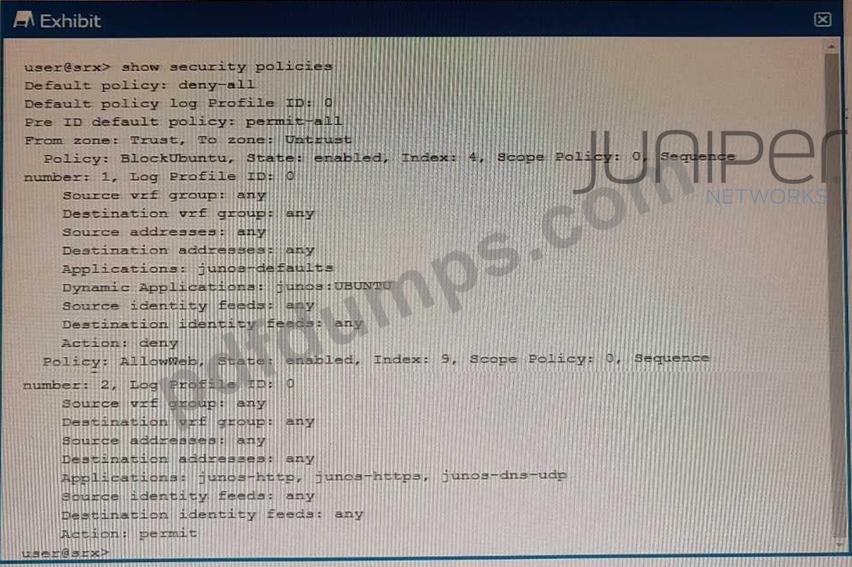
- A. Configure the Allowweb policy to have a dynamic application of any.
- B. Move the Blockubuntu policy after the Allowweb policy.
- C. Change the default policy to permit-all.
- D. Configure the Blockubuntu policy with the junos-https application parameter.
Answer: D
NEW QUESTION # 73
Which two statements are correct about chassis clustering? (Choose two.)
- A. The cluster ID is used to identify each device in the chassis cluster.
- B. The node ID is used to identify each device in the chassis cluster.
- C. A system reboot is required to activate changes to the cluster.
- D. The node ID value ranges from 1 to 255.
Answer: B,D
Explanation:
The node ID value ranges from 1 to 255 and is used to identify each device in the chassis cluster.
The cluster ID is also used to identify each device, but it is not part of the node ID configuration. A system reboot is not required to activate changes to the cluster, but it is recommended to ensure that all changes are applied properly.
NEW QUESTION # 74
Referring to the exhibit, which statement is true?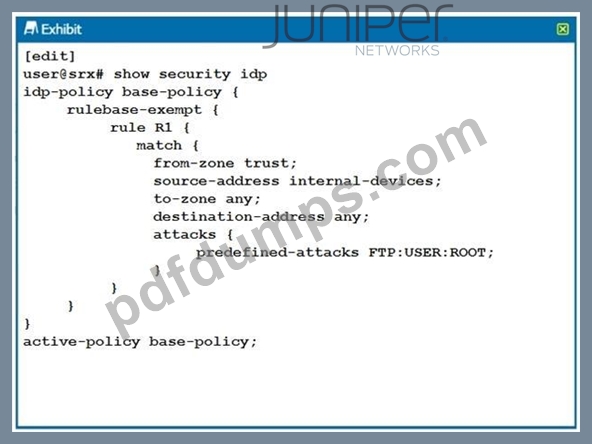
- A. IDP blocks all users.
- B. IDP blocks root users.
- C. IDP closes the connection on matched sessions.
- D. IDP ignores the connection on matched sessions.
Answer: D
NEW QUESTION # 75
......
The JN0-335 exam covers a variety of topics related to network security, including security policies, firewall filters, virtual private networks (VPNs), intrusion detection and prevention (IDP), and unified threat management (UTM). JN0-335 exam is designed to test an individual's knowledge of these topics and their ability to apply this knowledge in real-world situations.
Pass Juniper JN0-335 Exam in First Attempt Easily: https://www.pdfdumps.com/JN0-335-valid-exam.html
Practice Test Questions Verified Answers As Experienced in the Actual Test!: https://drive.google.com/open?id=1P7OV5tDBD9kKL0U9tQ-UrU6CU-BixWS9