


HPE7-J02 Actual Questions - Instant Download Tests Free Updated Today!
Get instant access of 100% real HP HPE7-J02 exam questions with verified answers
NEW QUESTION # 11
A company needs to replicate critical storage volumes to a secondary site for disaster recovery purposes.
Which capability is required?
- A. Local snapshot scheduling on individual servers only
- B. Remote replication between production storage arrays
- C. Standard desktop antivirus protection configuration
- D. Wireless network optimization for remote offices
Answer: B
Explanation:
Remote replication copies data between storage arrays at separate locations, supporting disaster recovery objectives. If the primary site fails, workloads can be recovered from replicated storage at the secondary location.
NEW QUESTION # 12
A customer is replacing their HPE 3PAR 8200 Peer Persistence setup with Alletra 6000. In a recent audit, they were warned that the Quorum Witness VM was missing security updates.
How would you respond regarding the new setup?
- A. Quorum witness is deployed as a SaaS option, and security updates are applied automatically.
- B. Quorum witness appliance can be set to automatically download and apply available updates.
- C. Quorum witness is installed as a service on a supported Linux server, which can be updated as needed.
- D. Quorum witness appliance security patch updates follow the array release train updates.
Answer: A
Explanation:
With Alletra and Primera Peer Persistence, the Quorum Witness is no longer a self-hosted VM. It is delivered as a cloud-based SaaS service managed by HPE. This eliminates customer responsibility for patching and ensures HPE automatically applies updates and security fixes.
This resolves the audit concern.
NEW QUESTION # 13
Refer to the exhibit. Your customer had an unexpected failure of their current storage array, causing them to lose some of their critical data.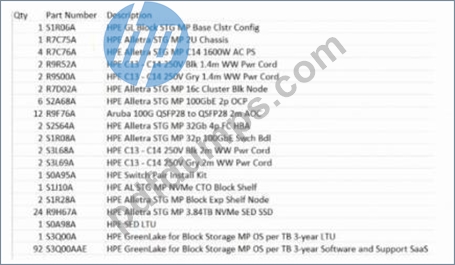
As a result, they are looking for a storage array with a guarantee of 100% data availability to prevent this failure and loss in the future.
They need 80TB raw and two new 25GbE top-of-rack switches to connect to their environment.
They expect 5% annual growth.
Which correction should be made to the configuration in the exhibit to meet the customer's requirements?
- A. Change to 25G networking
- B. HPE GreenLake financial model
- C. Decrease to 20 × 3.84TB drives
- D. Add 2× Aruba 8325 switches
Answer: A
Explanation:
The exhibit shows the use of 32Gb FC HBAs and 100GbE switches (Aruba 100G). However, the customer specifically requires 25GbE top-of-rack switches. Therefore, the configuration needs to be corrected to 25GbE networking. The HPE Alletra MP B10000 guarantees 100% data availability SLA, so the primary correction is networking alignment, not drives or financial model.
NEW QUESTION # 14
You are working with a customer to upgrade their current VMware infrastructure. The hardware is outdated, and the customer has no information about performance requirements for the new servers and storage array. You are using HPE CloudPhysics to run an assessment. Which Card Deck will give you insights on the under- and overprovisioning of the current environment?
- A. Reclaimable VMware vDisk Space
- B. Simulator for VM Rightsizing
- C. Storage Space Management
- D. Infrastructure Planning
Answer: B
Explanation:
The Simulator for VM Rightsizing Card Deck in HPE CloudPhysics evaluates actual VM utilization against provisioned resources. It identifies under- and overprovisioned VMs, providing insights into reclaimable resources and accurate sizing recommendations. This directly helps plan server and storage upgrades.
NEW QUESTION # 15
You are sizing an HPE Alletra Storage MP B10000 array (graphic provided).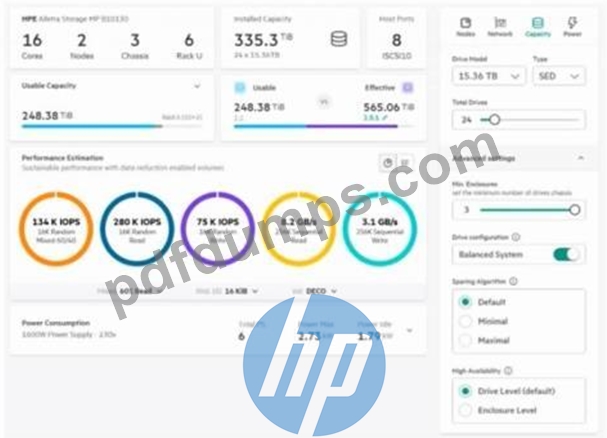
What happens when the High Availability (HA) option is switched from Drive Level to Enclosure Level?
- A. The Usable Capacity for the array decreases when selecting Enclosure Level HA
- B. The Enclosure Level option is not possible with the current number of disk enclosures
- C. The Enclosure Level option is only available with a switched configuration
- D. The estimated performance decreases due to lower IOPS and GB/s values
Answer: A
Explanation:
Changing HA from Drive Level to Enclosure Level means the system must reserve additional capacity to tolerate the loss of an entire disk enclosure. This decreases usable capacity, as more parity/spare space is required. Performance remains similar, but capacity overhead increases.
NEW QUESTION # 16
Two HPE Storage Alletra MP B10000 arrays are deployed with Active Peer Persistence. Both arrays and hosts are installed in close proximity to each other. To enable symmetric access, Peer Persistence must be configured accordingly.
Which Host Proximity Parameter should be selected for host ESX31 in this case?
- A. Secondary
- B. Primary
- C. Exclusive
- D. All
Answer: D
Explanation:
Detailed Explanation:
Rationale for Correct Answer:
Option B (All) is correct because in an Active Peer Persistence deployment where both arrays and hosts are in close proximity (metro or campus cluster scenario), the hosts should be configured with Host Proximity = All. This ensures that the host (ESX31) can access both arrays symmetrically and concurrently, enabling active-active paths. This is essential to deliver seamless failover and load balancing across the arrays in an HPE Alletra MP Peer Persistence environment.
Analysis of Incorrect Options (Distractors):
A (Secondary): This is used for hosts located closer to the secondary array, to bias access toward it in asymmetric deployments. Not applicable here since the hosts are near both arrays.
C (Exclusive): This option assigns the host to a single array exclusively, preventing dual-active access.
This would defeat the purpose of symmetric Peer Persistence.
D (Primary): Similar to Secondary, this biases access to only the primary array, which is not correct when arrays and hosts are in the same site for active-active.
Key Concept:
This question focuses on Host Proximity parameters in HPE Peer Persistence.
Primary/Secondary = asymmetric designs (hosts closer to one array).
All = symmetric design (hosts equidistant to both arrays, enabling active-active).
Exclusive = restricts access to one array only.
Reference:
HPE Alletra MP Storage Peer Persistence Best Practices Guide
HPE Primera/Alletra Remote Copy and Peer Persistence Technical White Paper VMware Metro Storage Cluster with HPE Peer Persistence Implementation Notes
NEW QUESTION # 17
You are sizing an HPE Alletra 5030. Unless otherwise indicated by the HPE sizer or the customer's requirements, HPE best practices state that you should default to which minimum FDR calculation?
- A. 23% of the largest drive size
- B. Above 12% for low-read latency
- C. 23% of the smallest drive size
- D. Below 12% for low-read latency
Answer: A
Explanation:
In Alletra 5000/6000 sizing, the Failure Domain Reserve (FDR) is used to account for rebuild overhead in case of drive failure. HPE best practices define that, unless otherwise directed by the sizing tool or customer requirements, the minimum FDR value should be set to 23% of the largest drive size. This ensures enough reserve capacity for fault tolerance and sustained performance during rebuilds.
NEW QUESTION # 18
Select the scenario where implementing FCoE would be an appropriate solution.
- A. A company with data centers in different states wants to establish a unified SAN infrastructure.
The goal is to centralize storage management across all sites, using a single protocol that can efficiently handle high-latency, long-distance connections between data centers. - B. A corporation needs to replicate data between data centers in different countries. The data must be synchronized in real-time across a WAN, and the solution must tolerate variable network conditions with minimal impact on performance.
- C. A large enterprise data center with existing Fibre Channel SANs is looking to reduce hardware complexity and costs by consolidating their storage and production networks onto a single infrastructure, while maintaining high performance for mission-critical applications.
- D. A tech startup is developing an AI-based application that relies heavily on machine learning models. The team needs a solution that allows them to access and process large datasets in the cloud.
Answer: C
Explanation:
Fibre Channel over Ethernet (FCoE) is designed for large enterprise environments that already have Fibre Channel (FC) infrastructures but want to simplify cabling and reduce hardware by converging LAN and SAN traffic over a single Ethernet fabric. FCoE retains the efficiency, low latency, and reliability of Fibre Channel while leveraging Ethernet to minimize physical infrastructure costs. This aligns with HPE's best practices for environments using HPE Alletra
9000/Primera or HPE Nimble arrays connected to converged networks where cost reduction and high performance are equally important.
NEW QUESTION # 19
A global financial services company is looking to enhance its disaster recovery (DR) capabilities.
They operate VMware workloads across multiple data centers and a mix of AWS and Azure cloud workloads. They need a solution that can replicate data with near-zero recovery point objectives (RPOs) and orchestrate rapid recovery of critical applications in case of a site-wide failure.
- A. Cohesity
- B. SimpliVity
- C. Zerto
- D. CommVault
Answer: C
Explanation:
Zerto, now part of HPE, provides continuous data protection (CDP) with near-zero RPOs and very low RTOs. It supports VMware workloads, as well as hybrid cloud deployments with AWS and Azure. Zerto is specifically designed for disaster recovery orchestration, enabling automated failover, failback, and application-consistent protection across sites and cloud environments.
NEW QUESTION # 20 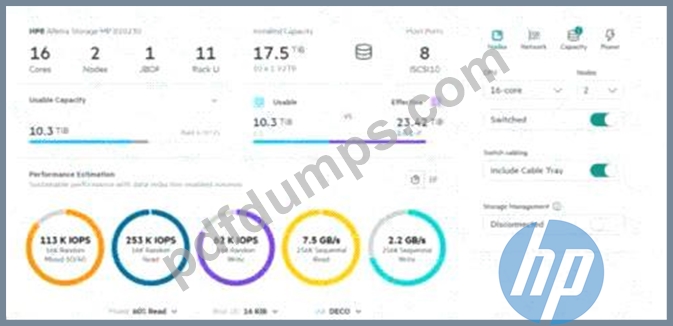
You are sizing an HPE Alletra Storage MP B10000 as shown in the graphic below.
What change must be made to the current storage configuration to achieve maximum IOPS performance?
- A. The controller must be upgraded to a 32-core model
- B. No change needed - the system is already operating at maximum performance
- C. Additional disks need to be added to the system
- D. Additional network cards or HBAs need to be added for more throughput
Answer: B
Explanation:
Detailed Explanation:
Rationale for Correct Answer:
From the exhibit, the system shows maximum estimated IOPS performance (over 250K IOPS read, 115K IOPS mixed, 62K write). These values align with HPE's published performance specifications for this model with full cores enabled. The network interface count and disk count are balanced relative to controller capability. Therefore, no further upgrades are required to achieve maximum performance.
Distractors:
A: Adding NICs/HBAs may improve throughput but will not exceed controller-bound IOPS.
B: Adding disks increases capacity, not peak IOPS, as performance is primarily controller-driven.
D: The system already matches controller capability; upgrading cores is not an option in Alletra MP B10000 mid-range systems.
Key Concept: Understanding performance sizing based on controller and architecture limits, not just capacity or NICs.
Reference: HPE Alletra MP Performance and Sizing Guide.
NEW QUESTION # 21
Select the scenario where implementing FCoE would be an appropriate solution.
- A. A tech startup is developing an AI-based application that relies heavily on machine learning models.The team needs a solution that allows them to access and process large datasets in the cloud.
- B. A company with data centers in different states wants to establish a unified SAN infrastructure. The goal is to centralize storage management across all sites, using a single protocol that can efficiently handle high-latency, long-distance connections between data centers.
- C. A corporation needs to replicate data between data centers in different countries. The data must be synchronized in real-time across a WAN, and the solution must tolerate variable network conditions with minimal impact on performance.
- D. A large enterprise data center with existing Fibre Channel SANs is looking to reduce hardware complexity and costs by consolidating their storage and production networks onto a single infrastructure, while maintaining high performance for mission-critical applications.
Answer: D
Explanation:
Detailed Explanation:
Rationale for Correct Answer:
Option A is correct because Fibre Channel over Ethernet (FCoE) is designed for large enterprise environments that already have Fibre Channel (FC) infrastructures but want to simplify cabling and reduce hardware by converging LAN and SAN traffic over a single Ethernet fabric. FCoE retains the efficiency, low latency, and reliability of Fibre Channel while leveraging Ethernet to minimize physical infrastructure costs.
This aligns with HPE's best practices for environments using HPE Alletra 9000/Primera or HPE Nimble arrays connected to converged networks where cost reduction and high performance are equally important.
Analysis of Incorrect Options (Distractors):
B: Real-time replication across WANs requires protocols like HPE 3PAR/Alletra Remote Copy, asynchronous/synchronous replication, or HPE Peer Persistence. FCoE is not suited for high-latency WANs because it is a LAN protocol designed for short distances within a data center.
C: For inter-data center SAN unification, FCIP (Fibre Channel over IP) or iSCSI are more suitable. FCoE does not handle long-distance high-latency links effectively.
D: A startup building AI applications with cloud workloads typically benefits from object storage (HPE Scality RING, HPE GreenLake for File and Object) or direct cloud-native APIs (S3/Blob). FCoE is irrelevant in this use case since it is on-prem and infrastructure-focused.
Key Concept:
The question is testing knowledge of FCoE and its appropriate deployment scenarios - specifically, its role in consolidating storage and network traffic inside enterprise data centers while preserving Fibre Channel protocol advantages.
Reference:
HPE Storage Networking Best Practices Guide
HPE Primera/Alletra 9000 Technical White Paper
Fibre Channel over Ethernet Standards Overview (IEEE 802.1Qbb, 802.1Qaz)
NEW QUESTION # 22
An administrator is deploying HPE storage in a Microsoft Hyper-V cluster. The customer requires fast failover and high availability.
Which configuration is most important?
- A. Daily manual backup verification procedures only
- B. Standalone local disks inside every Hyper-V server
- C. Single network adapter for cluster communication traffic
- D. Shared storage with Cluster Shared Volumes enabled
Answer: D
Explanation:
Cluster Shared Volumes (CSV) enable multiple Hyper-V hosts to access shared storage simultaneously. This configuration supports rapid failover, high availability, and simplified management for clustered virtual machine environments.
NEW QUESTION # 23
You are working with a customer to upgrade their backup target environment and they are interested in HPE StoreOnce.
Which HPE tool should you use to size and configure a solution for this customer?
- A. HPE CloudPhysics
- B. HPE NinjaSTARS
- C. HPE Ninja Online
- D. One Config Advanced
Answer: B
Explanation:
Detailed Explanation:
Rationale for Correct Answer:
HPE NinjaSTARS (Storage Assessment and Right Sizing) is the dedicated HPE tool for sizing and configuring StoreOnce backup appliances. It evaluates backup datasets, retention policies, deduplication ratios, and replication to recommend the right StoreOnce model and configuration.
Distractors:
A (CloudPhysics): Used for virtual infrastructure and block storage assessments, not backup target sizing.
C (Ninja Online): General sizing tool, not specific for StoreOnce.
D (OCA): Used for quoting/configuration, but sizing requires NinjaSTARS first.
Key Concept: HPE NinjaSTARS is the StoreOnce sizing tool.
Reference: HPE NinjaSTARS Backup Sizing Tool Guide.
NEW QUESTION # 24
An organization requires non-disruptive storage maintenance while ensuring continuous application availability for critical workloads.
Which feature should be recommended?
- A. Dedicated standalone management workstation only
- B. Multipathing with redundant controller failover support
- C. Local USB backup storage for emergency access
- D. Single-controller storage deployment architecture
Answer: B
Explanation:
Multipathing combined with redundant controller failover ensures continuous data access during maintenance or hardware failures. If one path or controller becomes unavailable, traffic automatically switches to alternate operational paths without disrupting applications.
NEW QUESTION # 25
Your customer is a software development company using Kubernetes, Canonical, and Tanzu.
They are expanding their Dev/Ops container environment and are considering HPE Private Cloud Business Edition (PCBE).
What is a unique benefit that HPE PCBE would bring to this customer's environment?
- A. Infinite scale to the customer at no additional cost
- B. Multi-tenant VASA
- C. Full stack intelligence
- D. Container level protection
Answer: C
Explanation:
HPE PCBE provides full-stack intelligence across compute, storage, and virtualization layers. It integrates with Kubernetes distributions like Tanzu and Canonical, giving visibility and lifecycle automation across the entire stack. This helps Dev/Ops teams simplify operations, capacity planning, and performance optimization in hybrid environments.
NEW QUESTION # 26
A pool of Microsoft SQL servers started to use the Alletra 6000 family array six months ago. The data growth has been higher than expected, and the performance of the databases is facing some latency issues.
Which method would allow both capacity and performance to grow when expanding the array, while keeping the management simple?
- A. By selecting more flash to cache ratio on the expansion shelves.
- B. By adding more arrays and capacity to a single scale-out group.
- C. By including more NIC cards to load balance host traffic.
- D. By initially selecting the timeless storage option for the array.
Answer: B
Explanation:
Detailed Explanation:
Rationale for Correct Answer:
HPE Alletra 6000 is a scale-out architecture array. Adding more arrays to a single scale-out group increases both performance (IOPS, throughput) and capacity, while maintaining single-pane management via HPE Data Services Cloud Console. This is the most efficient way to address both capacity growth and latency reduction for SQL workloads.
Distractors:
B: Adding NICs may help with throughput but not backend latency or capacity scaling.
C: Flash-to-cache ratios can optimize read caching but don't fundamentally increase system-wide performance.
D: Timeless storage is a procurement/licensing option, not a performance/capacity scaling method.
Key Concept: Alletra 6000 scale-out clustering for balanced growth of capacity and performance.
Reference: HPE Alletra 6000 Technical Architecture Guide.
NEW QUESTION # 27
You are troubleshooting a storage environment using HPE Alletra Storage MP B10000 in a Peer Persistence configuration. A customer reports high latency when accessing data from applications. When reviewing the MPIO path status on the host, what should be the path status for connections to the storage array located in the remote data center?
- A. Active Optimized
- B. Passive
- C. Active Non-optimized
- D. Standby
Answer: C
Explanation:
In an HPE Peer Persistence configuration (supported on HPE Alletra MP, Primera, and 3PAR), hosts see volumes presented from arrays at both sites. For optimal load balancing and transparent failover, the local array paths are shown as "Active Optimized" while the remote array paths are marked "Active Non-optimized". The "Non-optimized" label indicates these paths are functional but involve remote access with higher latency. This design ensures automatic transparent failover if the local site becomes unavailable.
NEW QUESTION # 28
Your customer wants to use their HPE Alletra Storage MP B10000 array to store persistent data for Kubernetes-based applications. After deploying the CSI driver using Helm and creating the secret with the command kubectl create -f hpe-backed.yaml, what is the next required step to enable the containerized applications to consume persistent volumes on the Alletra MP array?
- A. Update the Helm repository by using helm repo update to recognize the CSI driver
- B. Define a StorageClass by running kubectl create -f storageclass.yaml
- C. Create a PersistentVolumeClaim by using kubectl create -f my-pvc.yaml
- D. Create a PersistentVolume by using kubectl create -f pv.yaml
Answer: B
Explanation:
After installing the HPE CSI driver and creating backend secrets, the next critical step is to define a StorageClass that references the backend driver and parameters. Without the StorageClass, Kubernetes cannot dynamically provision PersistentVolumes (PVs). Once the StorageClass is created, workloads can request storage using PersistentVolumeClaims (PVCs).
NEW QUESTION # 29
You are troubleshooting a storage environment using HPE Alletra Storage MP B10000 in a Peer Persistence configuration. A customer reports high latency when accessing data from applications.
When reviewing the MPIO path status on the host, what should be the path status for connections to the storage array located in the remote data center?
- A. Active Optimized
- B. Passive
- C. Active Non-optimized
- D. Standby
Answer: C
Explanation:
Detailed Explanation:
Rationale for Correct Answer:
In an HPE Peer Persistence configuration (supported on HPE Alletra MP, Primera, and 3PAR), hosts see volumes presented from arrays at both sites. For optimal load balancing and transparent failover, the local array paths are shown as "Active Optimized" while the remote array paths are marked "Active Non- optimized". The "Non-optimized" label indicates these paths are functional but involve remote access with higher latency. This design ensures automatic transparent failover if the local site becomes unavailable.
Distractors:
A: "Active Optimized" applies only to local array paths, not remote ones.
B: Passive paths are typical of ALUA implementations without Peer Persistence, not here.
D: "Standby" is not the term used in Peer Persistence multipathing.
Key Concept: MPIO with Peer Persistence (ALUA Active/Active configuration).
Reference: HPE Primera/Alletra Peer Persistence Best Practices Guide.
NEW QUESTION # 30
You are migrating your customer's virtualization platform from an old third-party storage array to a newly installed HPE Alletra MP B10000 array. You are using HPE Zerto Move for the migration.
Which statement is correct when using HPE Zerto Move compared to the typical Failover feature?
- A. You can keep the source VMs after the migration
- B. The Zerto Checkpoint (and RPO) is user-selectable during the move
- C. The source VMs are deleted automatically after the migration
- D. The migration results in an RPO and RTO of seconds
Answer: A
Explanation:
Detailed Explanation:
Rationale for Correct Answer:
When using Zerto Move, unlike a typical disaster recovery failover, the migration process allows the source VMs to be retained after cutover. This is useful when testing or validating the migration. In contrast, failover scenarios typically assume the source environment has failed or is decommissioned. Therefore, keeping source VMs is a differentiator for Move.
Distractors:
A: Checkpoints and RPO are controlled by Zerto replication but are not selectable per migration cutover in this way.
B: Source VMs are not deleted automatically; this is intentionally avoided to allow rollback.
D: While Zerto does provide low RPO/RTO (seconds to minutes), this applies mainly to DR failover, not migration cutovers.
Key Concept: Zerto Move vs Zerto Failover semantics.
Reference: HPE Zerto Move Technical Overview, HPE Zerto Replication & Migration Best Practices.
NEW QUESTION # 31
Refer to the exhibit.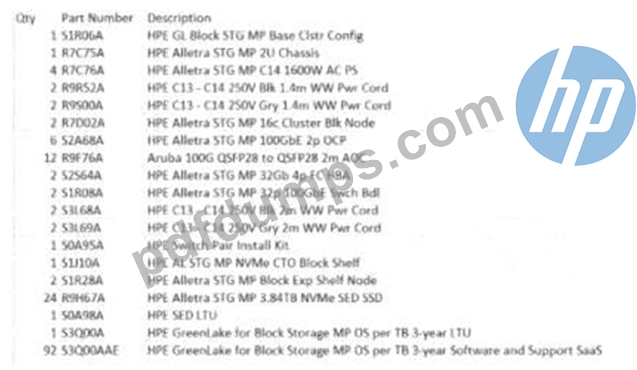
Your customer had an unexpected failure of their current storage array, causing them to lose some of their critical data. As a result, they are looking for a storage array with a guarantee of 100% data availability to prevent this failure and loss in the future.
They need 80TB raw and two new 25GbE top-of-rack switches to connect to their environment.
They expect 5% annual growth.
Which correction should be made to the configuration in the exhibit to meet the customer's requirements?
- A. Change to 25G networking
- B. HPE GreenLake financial model
- C. Decrease to 20 × 3.84TB drives
- D. Add 2× Aruba 8325 switches
Answer: A
Explanation:
Detailed Explanation:
Rationale for Correct Answer:
The exhibit shows the use of 32Gb FC HBAs and 100GbE switches (Aruba 100G). However, the customer specifically requires 25GbE top-of-rack switches. Therefore, the configuration needs to be corrected to
25GbE networking. The HPE Alletra MP B10000 guarantees 100% data availability SLA, so the primary correction is networking alignment, not drives or financial model.
Distractors:
B: Reducing drives reduces raw capacity below 80TB requirement.
C: GreenLake is a consumption model but not the technical correction required.
D: Aruba 8325 is a core switch option; customer only asked for ToR 25GbE.
Key Concept: Networking alignment with requirements.
Reference: HPE Alletra MP Ordering and Configuration Guide.
NEW QUESTION # 32
You are migrating your customer's virtualization platform from an old third-party storage array to a newly installed HPE Alletra MP B10000 array. You are using HPE Zerto Move for the migration.
Which statement is correct when using HPE Zerto Move compared to the typical Failover feature?
- A. You can keep the source VMs after the migration
- B. The Zerto Checkpoint (and RPO) is user-selectable during the move
- C. The source VMs are deleted automatically after the migration
- D. The migration results in an RPO and RTO of seconds
Answer: A
Explanation:
When using Zerto Move, unlike a typical disaster recovery failover, the migration process allows the source VMs to be retained after cutover. This is useful when testing or validating the migration. In contrast, failover scenarios typically assume the source environment has failed or is decommissioned. Therefore, keeping source VMs is a differentiator for Move.
NEW QUESTION # 33
You are sizing an HPE Alletra Storage MP B10000 array (graphic provided).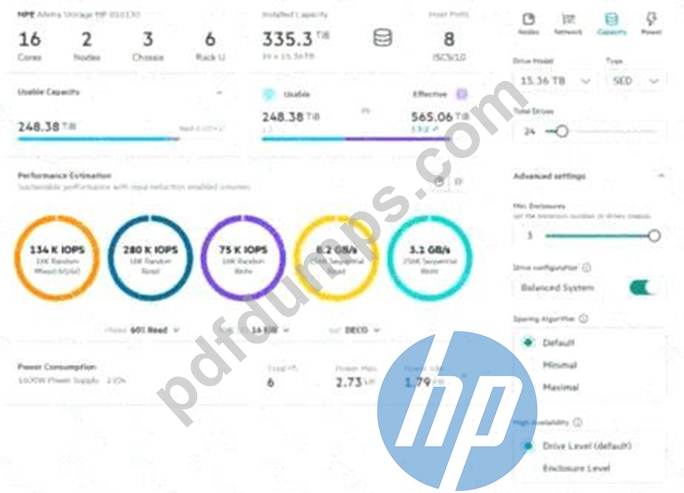
What happens when the High Availability (HA) option is switched from Drive Level to Enclosure Level?
- A. The Usable Capacity for the array decreases when selecting Enclosure Level HA
- B. The Enclosure Level option is not possible with the current number of disk enclosures
- C. The Enclosure Level option is only available with a switched configuration
- D. The estimated performance decreases due to lower IOPS and GB/s values
Answer: A
Explanation:
Detailed Explanation:
Rationale for Correct Answer:
Changing HA from Drive Level to Enclosure Level means the system must reserve additional capacity to tolerate the loss of an entire disk enclosure. This decreases usable capacity, as more parity/spare space is required. Performance remains similar, but capacity overhead increases.
Distractors:
A: Multiple enclosures exist in the config; option is valid.
B: Switched vs direct-connect is unrelated to HA settings.
C: Performance estimates are not directly reduced by HA level change; capacity is.
Key Concept: Enclosure HA = more reserve overhead # less usable capacity.
Reference: HPE Alletra MP Sizing Tool User Guide.
NEW QUESTION # 34
A financial services company is planning to upgrade its data center infrastructure. Their considerations are:
Budget Management: Prefer one-time expense, avoid variable costs.
Flexibility: Growth planned in yearly budget cycles.
Ownership: Want to own equipment outright.
Operational Control: Full control of equipment lifecycle and customization.
Which procurement option best meets these needs?
- A. Capital purchase
- B. Capital lease
- C. Consumption model
- D. Operating lease
Answer: A
Explanation:
Detailed Explanation:
Rationale for Correct Answer:
The requirements align with a Capital Purchase - outright ownership with a one-time CapEx expense. This provides complete lifecycle control and no ongoing payments, fitting the financial services company's budgeting and governance model.
Distractors:
A: Operating lease is OpEx, variable payments, and no ownership.
B: Capital lease provides eventual ownership but still requires periodic lease payments.
C: Consumption model (e.g., GreenLake) uses variable OpEx, opposite of the customer's request.
Key Concept: CapEx model = one-time purchase, ownership, full control.
Reference: HPE Financial Services Procurement Options Guide.
NEW QUESTION # 35
A junior engineer doing their first assessment makes the comment that all assessments are basically done
"entirely by the assessment tool" and all they must do is start the process in the HPE website.
You caution them that some assessment tools require a manual email by the engineer to HPE to really start the process.
Which type of assessments require an email?
- A. SAF
- B. Non-HPE
- C. CloudPhysics
- D. Backup
Answer: A
Explanation:
Detailed Explanation:
Rationale for Correct Answer:
The SAF (Storage Assessment Framework) requires engineers to manually email the collected assessment data to HPE for processing. This is different from fully automated tools like CloudPhysics or Backup assessments that integrate directly with portals. This distinction is important for new engineers performing customer assessments.
Distractors:
A: Backup assessments are usually tool-driven (StoreOnce, RMC, etc.) and automated.
C: Non-HPE assessments are outside scope and not part of HPE standard process.
D: CloudPhysics is fully automated and cloud-based - no manual email required.
Key Concept: SAF = requires manual email submission to HPE.
Reference: HPE Internal Assessment and Sizing Tools Guide.
NEW QUESTION # 36
......
Download Latest & Valid Questions For HP HPE7-J02 exam: https://www.pdfdumps.com/HPE7-J02-valid-exam.html
Exam Dumps for the Preparation of Latest HPE7-J02 Exam Questions: https://drive.google.com/open?id=1f3sEX2kUBXHa2aJWiWaKk18rialHNDwg