


AgilePM-Practitioner Questions Pass on Your First Attempt Dumps for AgilePM Certified
AgilePM-Practitioner Practice Test Pdf Exam Material
APMG-International AgilePM-Practitioner Exam Syllabus Topics:
| Topic | Details |
|---|---|
| Topic 1 |
|
| Topic 2 |
|
| Topic 3 |
|
| Topic 4 |
|
NEW QUESTION # 75
Which 2 statements represent appropriate entries for the plan for Post-Project activities?
- A. The Sales Manager will create a company-wide email showing the
number of policies sold weekly by each of the sales assistants. - B. Once the new system has been deployed, the time it takes to process sales online will be compared with the time it takes to process new policies sold through telephone sales.
- C. A report showing the number of application forms completed online
through the website for coffee shop insurance policies will be produced weekly. - D. Before the product is deployed, the Sales Manager will circulate a copy of the revised sales procedure for processing coffee shop insurance sales.
- E. The Project Manager will attend Daily Stand-up meetings to observe
progress.
Answer: B,C
Explanation:
For the XAN Insurance Company Web Project, the plan for Post-Project activities should include actions and measures that will be undertaken after the project's deliverables have been implemented to ensure sustained benefits, monitor performance, and facilitate continuous improvement.
Selected Statements for the Plan for Post-Project Activities:
D: A report showing the number of application forms completed online through the website for coffee shop insurance policies will be produced weekly.
E: Once the new system has been deployed, the time it takes to process sales online will be compared with the time it takes to process new policies sold through telephone sales.
D: Producing a weekly report on the number of application forms completed online is a clear post-project activity. It provides ongoing monitoring of the project's impact and the effectiveness of the online system in attracting coffee shop insurance policies.
E: Comparing the processing times of online sales to telephone sales after the new system's deployment is an essential post-project activity. It evaluates the efficiency and effectiveness of the new online system, offering insights into improvements and adjustments that may be needed.
Why Other Statements Are Excluded:
A: Creating a company-wide email to show the number of policies sold by each sales assistant weekly is more related to internal sales performance monitoring and motivation rather than a specific post-project activity tied to the project's objectives.
B: Circulating a copy of the revised sales procedure before product deployment is a preparation step for the transition to the new system, rather than a post-project activity.
C: The Project Manager attending Daily Stand-up meetings is part of the ongoing project management and team coordination activities during the project, not a post-project activity.
Topic 3, UniCo IT Service
The companies and people within the scenario are fictional.
UniCo
Background
UniCo is an IT Services company which offers information management services and installation of large-scale computer systems. The company has grown rapidly and has been successful. However in recent years UniCo has lost market share due to increased competition from a growing number of similar providers. There is also an increasing client demand for mobile applications and more innovative solutions.
Current situation
The Chief Executive Officer (CEO) has made a strategic decision to reposition UniCo in the market place. It will become a leading provider of innovative solutions, including mobile applications. The CEO knows that pursuing this new strategy will mean some loss of personal control in UniCo as he will no longer have the expertise to make decisions on all aspects of the technology, but believes the strategic shift is both necessary and urgent.
Two months ago, in line with the new strategy, UniCo acquired a company called Selco. Selco is a small, dynamic company that specializes in developing mobile applications. The plan is to keep the 10 Selco staff together as an intact team.
They will still be managed by the founder of Selco, who will become the Applications Manager within UniCo.
The resulting UniCo structure is shown in the Organization Chart on the next page.
In order for UniCo to achieve its new business priorities and meet the changing customer demands, UniCo staff need to learn from their new Selco colleagues.
They must develop both new capabilities and the new attitudes needed for UniCo to offer more innovative solutions to its customers. This may not happen easily, because some UniCo staff members are not enthusiastic about the change in focus of UniCo's business.
So far, very little integration has taken place. The former Selco staff still work from an office on the other side of town from the UniCo office. In order to make progress UniCo needs to realign business processes and systems, and to complete the integration of Selco.
The UniCo Sales Director has some experience of the mobile applications market and has recently won a large contract with a Utilities company to provide mobile solutions for their workforce. This is a great opportunity for UniCo to prove it can be successful in this new type of business.
Next steps
A programme has been established to manage this change. This consists of the following workstreams:
1. Operational delivery processes - The Operations Director will manage
. the integration of the Selco staff (now the Applications area) with UniCo's IT systems and work practices, and
. the relocation of the Selco staff to the UniCo office.
2. Business processes - The Customer Services Director will
manage the introduction of new processes across the business
to ensure end-to-end alignment of the new capability and
services to be offered.
3. Rebranding UniCo - The Marketing Manager will lead the work to
reposition UniCo in the market place.
4. Capability and skills development - The Human Resources (HR)
Manager will lead the work to upskill people so they are prepared and
able to take advantage of the new opportunities resulting from this
change.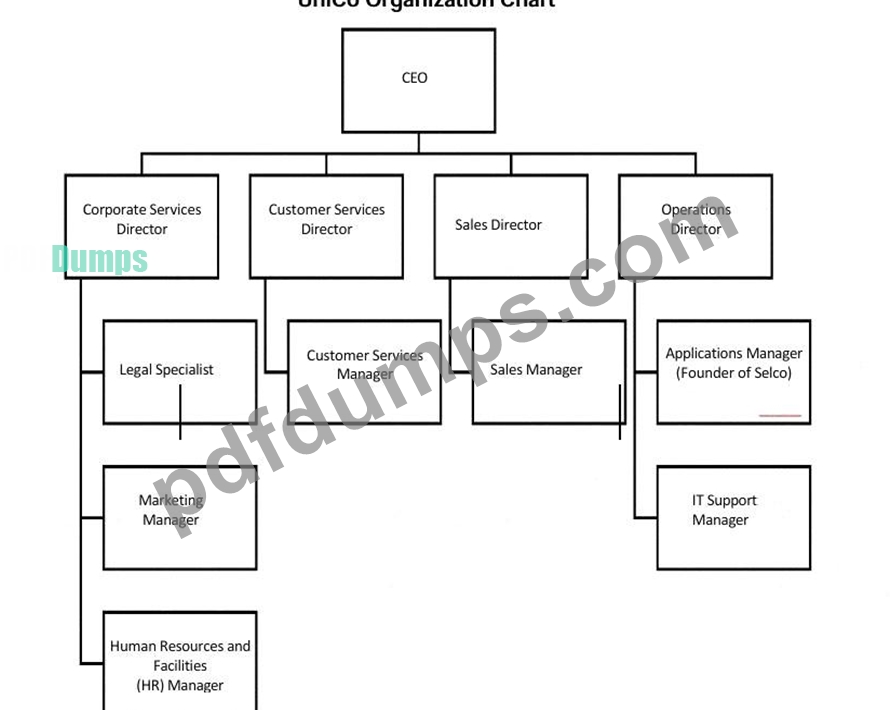
Additional Information:
The Marketing Manager is reviewing what needs to be done to implement the workstream for the market repositioning and rebranding of UniCo. Marketing staff have interviewed people at all levels in the organization to identify potential ideas and barriers. Key items have been identified as follows:
. UniCo has an excellent brand perception within the market and many existing staff feel that this existing brand will be damaged by the inclusion of Selco
. Internally, the Customer Services and IT Support managers and the Corporate Services Director, are not as committed to the rebranding as the Operations and Sales Directors
. A recent positive press article about the future direction of UniCo has been promoted on social media forums and has been well received and redistributed by staff
. At a company meeting the CEO admitted to being initially apprehensive about losing some personal control over the new direction for UniCo. However, the CEO enthusiastically explained how UniCo and Selco together will be much stronger in the market, especially following successful rebranding, and why the CEO is now able to support the change. Staff have appreciated this openness and it has been the subject of many informal discussions throughout the company.
The Sales Director has noted that there is some tension amongst the Sales Director's management team, particularly between those Sales Managers who have been at UniCo a long time and two new Managers who joined recently. This is of concern as it means the team is not working as effectively as it could.
The Sales Director has held one-to-one discussions with each Sales Manager in order to:
. try to understand the underlying tensions and
put measures in place to help them become a more effective team.
The extract below is from of the Sales Director's notes on the discussions, and includes the proposed plans to address the issues:
1. The most common complaint across the whole of the Sales management team was the time spent on internal processes, territorial conflicts between sales regions and which industries should be targeted. Commitment was lacking to the change management actions needed to increase the sales value to UniCo.
Plan: Arrange a Sales management event so that the Sales Managers can share their personal vision and priorities.
2. There are underlying tensions because new Sales Managers are doing some of the work that the longer-term Sales Managers would have been doing. Nobody has wanted to raise this at the Sales management team meetings as it was felt that they would not be taken seriously and it would affect how others viewed them.
2. There are underlying tensions because new Sales Managers are doing some of the work that the longer-term Sales Managers would have been doing. Nobody has wanted to raise this at the Sales management team meetings as it was felt that they would not be taken seriously and it would affect how others viewed them.
Plan: Agree individually with each Sales Manager a list of key tasks they are expected to fulfil and share these separately with the others in Sales management.
3. It has been a while since the last Sales management team meeting and some members have not completed the actions agreed to resolve outstanding issues, which has led to delays. There is a belief that these issues will not be resolved even if they are discussed again at the next Sales management team meeting.
Plan: Acknowledge the failure to complete previous actions and get all team members to debate and jointly agree a plan to implement future actions.
4. This is the first time the Sales staff have faced major disruption to the normal sales processes.
The Sales Director learned that some sales teams are not adopting the changes needed to support the sale of the mobile applications now being developed and marketed. However, the Sales Managers have not yet discussed and resolved this failure of some to deliver on commitments between themselves.
Plan: Ask the Sales Manager team members to take it in turns to attend meetings of other functional departments to gain more understanding of the organizational processes.
NEW QUESTION # 76
Answer the following question about different language style preferences identified by Pashler et. al. using VARK preferences.
As part of the Capability and skills development workstream, the Human
Resources (HR) Manager is considering the training needs of staff
managers undertaking staff appraisals. The HR Manager is designing the
learning activities so that they will appeal to differing ways for receiving and processing information.
Column 1 is a list of learning activities that could be used to develop the staff.
For each learning activity in Column 1, select from Column 2 the VARK
preference to which it relates. Each selection from Column 2 can be used once, more than once or not at all.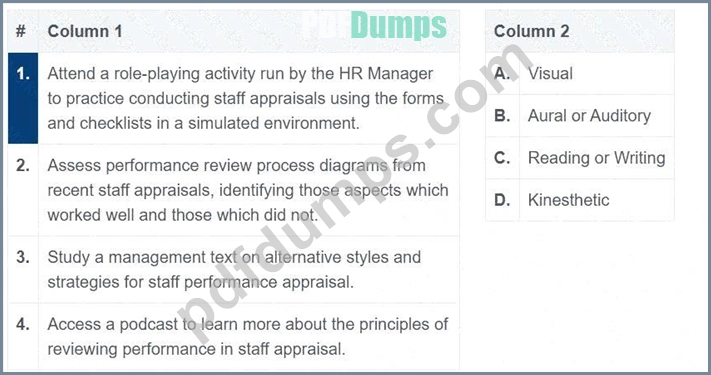
Answer:
Explanation: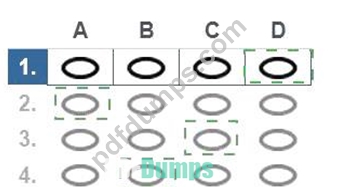
Explanation:
Answer the following question about different language style preferences identified by Pashler et. al.
using VARK preferences.
1. Attend a role-playing activity run by the HR Manager to practice conducting staff appraisals using the forms and checklists in a simulated environment.
* answer: D (Kinesthetic) Kinesthetic learners prefer hands-on, practical activities. Role-playing simulates real-life scenarios, enabling learning by doing, which appeals to this preference.
2. Assess performance review process diagrams from recent staff appraisals, identifying those aspects which worked well and those which did not.
* answer: A (Visual) Visual learners thrive on diagrams, charts, and graphical representations.
Reviewing performance review diagrams aligns perfectly with the visual preference.
3. Study a management text on alternative styles and strategies for staff performance appraisal.
* answer: C (Reading or Writing) This activity suits individuals who process information best through reading and writing. It involves textual analysis, making it a clear match.
4. Access a podcast to learn more about the principles of reviewing performance in staff appraisal.
* answer: B (Aural or Auditory) Podcasts provide auditory learning experiences. For learners with an auditory preference, listening to discussions and explanations is ideal.
Comprehensive and Detailed Step-by-Step Explanation:
* Role-playing activity (Kinesthetic) : The activity involves movement, interaction, and application in a simulated setup, which matches the hands-on approach kinesthetic learners prefer.
* Performance review diagrams (Visual) : Visual learners engage with content presented in diagrams or charts as these offer clarity through graphical representation.
* Management text (Reading/Writing) : The reliance on written material, such as texts, articles, or reports, is a strong indicator of the reading/writing preference.
* Podcast (Aural/Auditory) : Listening to content, such as in a podcast, aligns with auditory learning preferences, allowing learners to absorb spoken information effectively.
NEW QUESTION # 77
Which 2 actions demonstrate transparency?
- A. Distribute the key milestones and target dates for including Selco's mobile technology and approaches into the UniCo operations.
- B. Ask Corporate Services to provide guidelines to ensure all written communications are easy to read and navigate.
- C. Publish how staff members can raise complaints and suggestions, formally and anonymously if needed.
- D. Ensure everyone is treated fairly by providing the same information, in the same format, to everyone impacted by this change.
- E. Send daily emails to everyone to remind them how important this change is and why they should support it.
Answer: A,D
Explanation:
Comprehensive and Detailed Step-by-Step Explanation
Understanding Transparency in Change Management
Transparency refers to open communication, ensuring that stakeholders are well-informed and have access to relevant information. It promotes trust and reduces resistance to change by making the process visible and understandable.
Option Analysis
* A. Ensure everyone is treated fairly by providing the same information, in the same format, to everyone impacted by this change
* Providing consistent information ensures that all stakeholders receive the same details and feel equally valued, reinforcing transparency in communication.
* Correct.
* B. Send daily emails to everyone to remind them how important this change is and why they should support it
* While frequent communication is helpful, daily emails emphasizing importance can feel repetitive or coercive, which does not align with the principle of transparency.
* Incorrect.
* C. Distribute the key milestones and target dates for including Selco's mobile technology and approaches into the UniCo operations
* Sharing milestones and timelines increases clarity and accountability, providing stakeholders with a clear understanding of progress and expectations.
* Correct.
* D. Ask Corporate Services to provide guidelines to ensure all written communications are easy to read and navigate
* Although clarity in communication is valuable, creating guidelines focuses on internal documentation rather than openly sharing information with stakeholders.
* Incorrect.
* E. Publish how staff members can raise complaints and suggestions, formally and anonymously if needed
* While this supports inclusion and feedback, it does not inherently align with transparency as it focuses more on creating a feedback mechanism than on open sharing of information.
* Incorrect.
Why A and C are the Correct Answers (Scenario Alignment)
* A: Ensures equality in information dissemination, helping all stakeholders feel informed and included.
* C: Offers visibility into the change process, timelines, and progress, building trust through clear and open communication.
References (AgilePM and Scenario Alignment):
* AgilePM Handbook, Chapter 7: Transparent Communication Strategies in Change Management.
* UniCo Scenario: "UniCo staff must be kept informed of the integration process and timelines to align their efforts with the organization's goals."
* Agile Business Consortium - Importance of Milestones and Open Communication in Stakeholder Engagement.
NEW QUESTION # 78
Which statement should be recorded under the High-level timing considerations heading?
- A. Completing the large contract with a Utilities company over the next nine months is a vital step to achieving the end vision.
- B. UniCo lost significant market share in the last six months and faces ongoing increased competition in the next year.
- C. The traditional market has changed over the last year and UniCo can no longer rest on its previous success.
- D. UniCo's new finance system was delivered in the last quarter and training in the new system is almost complete.
Answer: A
Explanation:
Comprehensive and Detailed Step-by-Step Explanation:
The High-level timing considerations heading requires statements that emphasize critical timelines, milestones, or deadlines that need to be factored into the change strategy. Here's why D is the most appropriate choice:
1. Understanding High-Level Timing Considerations:
* Timing considerations refer to key deadlines, schedules, or milestones that impact the execution of the change strategy.
* This heading includes initiatives or actions that have a defined timeframe and are crucial for achieving the strategic goals.
2. Option Analysis:
* Option A: The traditional market has changed over the last year and UniCo can no longer rest on its previous success.
* This statement highlights a market condition but does not specify any timeline, milestone, or timing-related requirement. It is more about market trends than timing considerations.
* Eliminate.
* Option B: UniCo lost significant market share in the last six months and faces ongoing increased competition in the next year.
* This statement discusses recent performance and anticipated competition, but it lacks a clear timeline or milestone for action. It is focused on market dynamics, not timing.
* Eliminate.
* Option C: UniCo's new finance system was delivered in the last quarter and training in the new system is almost complete.
* While this mentions past timing, it does not align with the heading as it focuses on completed tasks rather than future timing or milestones.
* Eliminate.
* Option D: Completing the large contract with a Utilities company over the next nine months is a vital step to achieving the end vision.
* This statement provides a clear timeline ("next nine months") and links it to a critical milestone (completing the contract) that contributes directly to UniCo's strategic goals.
* Correct Answer.
3. Relevance in UniCo's Scenario:
* UniCo's focus on repositioning itself in the market and delivering innovative solutions makes the Utilities contract a pivotal milestone. The nine-month timeline directly impacts UniCo's ability to meet its strategic objectives and prove its capability in the new market segment.
4. Agile Practitioner Documentation References:
* Milestone Planning in Agile: Agile emphasizes prioritizing and delivering on critical milestones within time-boxed iterations.
* Strategic Alignment: High-level timing considerations in change strategies align with Agile principles by ensuring key initiatives are completed within the required timeframe to achieve overarching goals.
NEW QUESTION # 79
Using the project timeline given in the Project Scenario, answer the following question about application of Timeboxing on the Hoy Hall project.
Lines 1 to 5 in the table below consist of an assertion statement and a reason statement. For each line identify the appropriate option, from options A to E, that applies.
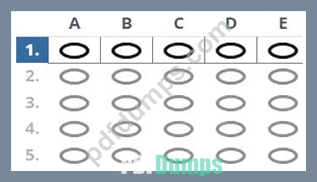
Each option can be used once, more than once or not at all.
Assertion :
1. All internal works to be assigned to Timber Tigers throughout the project should be consolidated into one Structured Timebox.
BECAUSE
The Investigation step within each Structured Timebox requires everyone working within the team to jointly agree how the requirements of the Timebox will be met.
2. Acceptance criteria for the front rooms to be developed in Timebox A should be described in detail and agreed during the Timebox Kick-Off BECAUSE The aim of the Investigation step within each Timebox is to complete as much of the development work as possible.
3. It is appropriate that both the Evolutionary Development phase and Deployment phase are shown in the first Project Increment.
BECAUSE
Each Timebox should comprise an Evolutionary Development phase and
Deployment phase.
4. It is appropriate that the outputs of Timebox C are scheduled for deployment at the end of the first Project Increment.
BECAUSE
A typical Timebox Plan should provide a schedule of high-level activities for the imminent Project Increment.
5. It is appropriate that Earth Excavations create a detailed plan of activities they will complete during Timebox C.
Reason
BECAUSE
The Solution Development Team is responsible for planning the detail of all the work of each Timebox.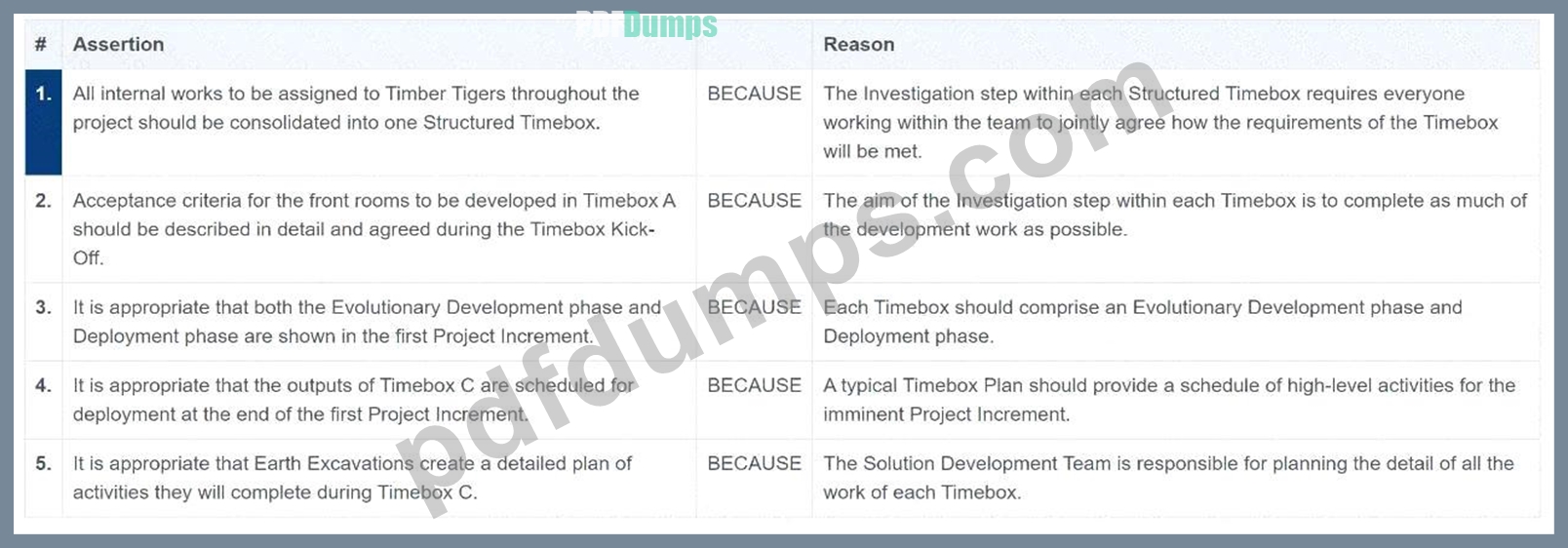
Answer:
Explanation: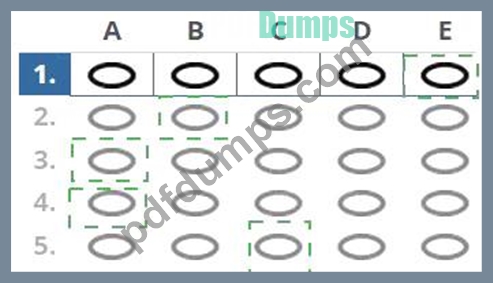
Explanation:
For each line, here is the appropriate option from A to E that applies:
* All internal works to be assigned to Timber Tigers throughout the project should be consolidated into one Structured Timebox.
* E. False (Assertion) False (Reason)
* Rationale: It is not practical or in line with Agile principles to consolidate all internal works into one Structured Timebox, as the work will likely need to be spread over multiple Timeboxes.
Additionally, the Investigation step involves agreeing on how to meet the requirements of the Timebox, not necessarily consolidating all work into one.
* Acceptance criteria for the front rooms to be developed in Timebox A should be described in detail and agreed during the Timebox Kick-Off
* B. True (Assertion) True (Reason) BUT the reason does not explain the assertion
* Rationale: While it is true that acceptance criteria should be agreed upon during the Timebox Kick-Off, the reason given is incorrect because the aim of the Investigation step is not necessarily to complete as much development work as possible but to plan and understand the work that will be carried out.
* It is appropriate that both the Evolutionary Development phase and Deployment phase are shown in the first Project Increment.
* A. True (Assertion) True (Reason) AND the reason explains the assertion
* Rationale: Each Timebox should indeed include both Evolutionary Development and a Deployment phase. This assertion and reason correctly align with the concept of Timeboxing in Agile.
* It is appropriate that the outputs of Timebox C are scheduled for deployment at the end of the first Project Increment.
* A. True (Assertion) True (Reason) AND the reason explains the assertion
* Rationale: The typical Timebox Plan does provide a schedule of high-level activities for the imminent Project Increment, which would include planning for deployment.
* It is appropriate that Earth Excavations create a detailed plan of activities they will complete during Timebox C.
* C. True (Assertion) False (Reason)
* Rationale: While it is true that Earth Excavations should create a detailed plan for their activities in Timebox C, the reason is incorrect as the Solution Development Team is not solely responsible for planning all work details within a Timebox. This task would typically be a collaborative effort involving all relevant parties.
NEW QUESTION # 80
A difference of opinion on the outcome of an earlier project has created a
'them and us' culture between the Sales Department and the Operations Department.
What action should the Project Manager take to resolve this?
- A. Brief the team and the Business Visionary on the use of an Agile Project Management approach and the requirement to collaborate.
- B. Appoint only those members of staff who are prepared to work collaboratively.
- C. Allow the different skillsets to work independently of one another so as not to create further conflict.
- D. Circulate a copy of the Business Case to all members of the Solution Development Team and project-level roles and invite feedback.
Answer: A
Explanation:
The most effective action the Project Manager should take to resolve the 'them and us' culture between the Sales Department and the Operations Department is:
B: Brief the team and the Business Visionary on the use of an Agile Project Management approach and the requirement to collaborate.
Addressing the cultural divide requires fostering an environment of collaboration and mutual respect. By educating all team members and the Business Visionary about Agile Project Management principles, which emphasize teamwork, collaboration, and collective ownership of project outcomes, the Project Manager can help shift the team's mindset towards a more unified approach. This briefing should highlight the value of diverse perspectives and the importance of working together towards common goals, thus addressing the underlying issues contributing to the 'them and us' culture. Encouraging open communication and collaboration as fundamental components of the Agile approach can help break down barriers and build a more cohesive team.
NEW QUESTION # 81
What action should the Project Manager take regarding the remaining windows?
- A. Insist that all available resources within the Solution Development Team are redirected to this work over the remaining two days.
- B. Decompose the individual elements of work to be completed on the windows and reprioritise them to meet the Minimum Usable Subset.
- C. Extend the time allocated to Timebox C, to allow time to complete these.
- D. All requirements that have not been met are automatically carried over to the next increment.
Answer: B
NEW QUESTION # 82
During the Foundations phase for Project Increment 4, Sukra Aroon held a meeting with Hira, Mira Bachar, andWanida Anong, to ensure alignment and compliance with EPR company policies, local regulations, and international standards. The meeting also clarified how financial and investment decisions would be made for Project Increment 4, ensuring alignment with EPR business priorities, and how this information will be tracked, controlled and evidenced.
Wanida Anong, who works across multiple sites worldwide, attended the meeting in person but has limited availability throughout the Project Increment.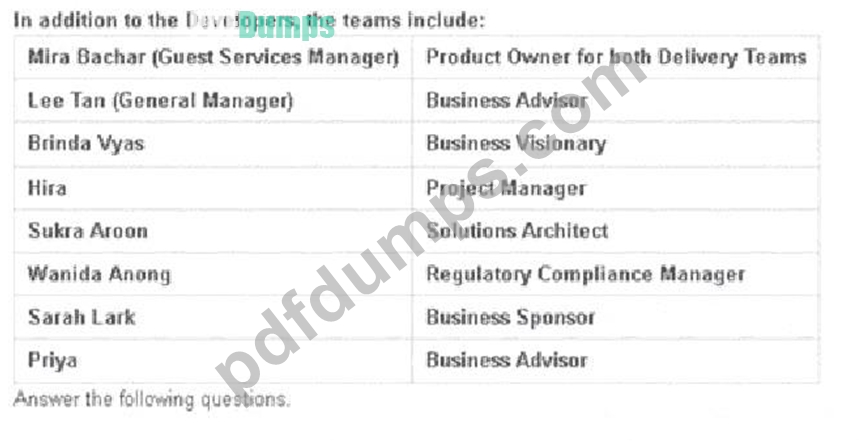
(During the meeting, Mira Bachar shared a query raised by Lee Tan. Lee has questioned how a business case can exist without a detailed understanding of exactly what will be delivered.
Which of the following is an appropriate explanation?)
- A. AgilePM business cases are based on a fixed scope, detailed upfront analysis and estimates. This approach is structured to reduce uncertainty by ensuring all major deliverables are accounted for from the start.
- B. AgilePM maximizes output efficiency, delivering complete, goal-aligned value on an incremental basis.
- C. In AgilePM, the business case focuses on project goals and benefits, using MoSCoW to ensure value delivery within fixed time and cost. This provides flexibility while maintaining control over investment.
- D. The business case in AgilePM uses incremental funding, adjusting investments as project priorities evolve and allowing the project to remain adaptable while still providing financial predictability.
Answer: C
Explanation:
The correct answer is A .
In AgilePM, the business case does not depend on having a fully fixed and detailed scope from the start.
Instead, it is based on:
* the business need ,
* expected benefits ,
* viability,
* and confidence that sufficient value can be delivered within agreed constraints.
Why A is correct:
* It correctly explains that AgilePM focuses on goals and benefits , not exhaustive detail upfront.
* It also correctly brings in MoSCoW prioritization , which helps ensure that the most important value is delivered first within fixed time and cost.
* This allows flexibility in lower-priority scope while maintaining investment control.
Why the other options are incorrect:
* B introduces incremental funding in a way that is not the core explanation here.
* C describes a predictive, fixed-scope model rather than AgilePM.
* D is too vague and does not directly explain how a business case can exist without detailed delivery certainty.
So the best answer is A .
NEW QUESTION # 83
Towards the end of the Foundations phase of Project Increment 4, with the high-level requirements agreed, Hira, has asked the Developers to estimate the work required to deliver the Eco spa solution.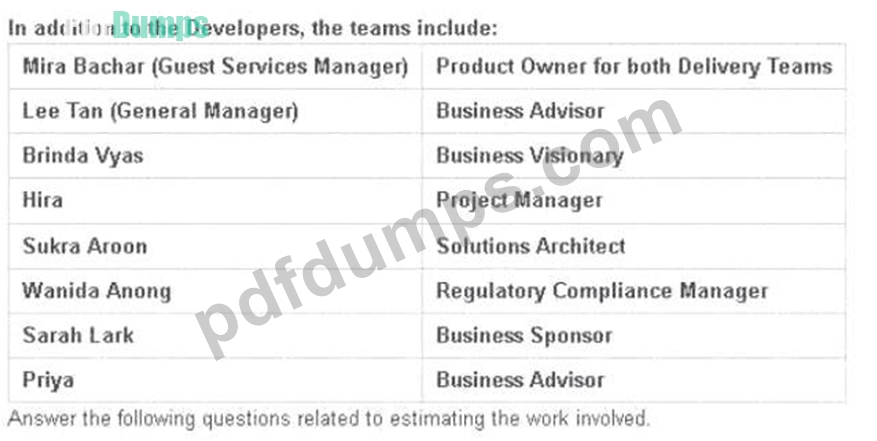
(Which of the following describes AgilePM ' s approach to estimation?)
- A. Estimates should only be revisited if stakeholders challenge them, as refining estimates too frequently causes unnecessary rework.
- B. Estimates should be as detailed as possible from the start to minimize uncertainty and reduce the need for later refinement.
- C. Estimates should be avoided whenever possible, as Agile projects must prioritize flexibility over predictability.
- D. The precision of estimates may vary as the project progresses, but they should always be as accurate as possible.
Answer: D
Explanation:
The correct answer is C .
In AgilePM, estimation is important, but it is understood that estimate precision evolves as the project progresses . Early in the project, there is less information available, so estimates are naturally broader. As delivery continues and more is learned, estimates can be refined and become more reliable.
This reflects a core AgilePM idea:
* estimates should be fit for purpose ,
* based on the information currently available,
* and improved progressively as understanding increases.
Why C is correct:
* AgilePM does not reject estimation.
* AgilePM does not expect perfect certainty at the start.
* AgilePM accepts that early estimates may be less precise, but they must still be honest, useful, and as accurate as reasonably possible .
Why the other options are incorrect:
A is incorrect because AgilePM does not avoid estimates. Estimation is needed for planning, prioritization, forecasting, and decision-making.
B is incorrect because AgilePM does not require maximum detail from the start. That would waste effort and conflict with iterative learning.
D is incorrect because estimates should be revisited when understanding changes, not only when stakeholders object.
So the best AgilePM answer is C .
NEW QUESTION # 84
Using the information provided in the additional information, answer the following question on building a change analytics strategy.
Are the measures and source data to be monitored by the Human Resources and Facilities Manager likely to have any of the limitations of data analytics?
- A. Yes, because the source data is unlikely to provide 'real-time' accuracy.
- B. Yes, because the volume of the source data is likely to be unmanageable.
- C. No, because internal processes are likely to ensure a good data quality.
- D. No, because reporting on staff data should only be carried out by Human Resources.
Answer: A
Explanation:
Comprehensive and Detailed Step-by-Step Explanation:
Context from the UniCo Scenario:
The Human Resources and Facilities Manager is responsible for tracking data related to the upskilling of staff in mobile applications, as well as analyzing training progress across departments. For effective change analytics, timely and accurate data is critical to enable actionable insights. Delays in reporting and inaccuracies can hinder real-time adjustments to training programs and resource allocation.
Analysis of the Answer Options:
* A. No, because reporting on staff data should only be carried out by Human Resources.
* Why Incorrect:This statement is irrelevant to the limitations of data analytics. While HR typically oversees reporting on staff data, the issue lies in the ability to provide real-time, accurate data for decision-making, not which department oversees the process.
* B. No, because internal processes are likely to ensure a good data quality.
* Why Incorrect:While internal processes might improve data quality, they do not guarantee timely or real-time accuracy. The issue highlighted in this scenario is the lag in data reporting, which limits its usefulness in dynamic change management.
* C. Yes, because the volume of the source data is likely to be unmanageable.
* Why Incorrect:There is no evidence in the scenario suggesting that the volume of data being collected for staff training is unmanageable. The challenge described pertains to the timeliness and accuracy of the data, not its scale.
* D. Yes, because the source data is unlikely to provide 'real-time' accuracy.
* Why Correct:Effective change analytics requires real-time data to monitor progress and make adjustments dynamically. In this case, the HR and Facilities Manager's reliance on data that is not timely or accurate limits the ability to intervene effectively during training or skill development.
Why D Is the Best answer:
* Real-Time Data Is Crucial for Change Analytics:
* AgilePM emphasizes the need for actionable insights derived from up-to-date information. Data that is delayed or inaccurate prevents quick responses to emerging issues.
* Alignment with Agile Principles:
* In change programs, especially those involving skill development, real-time feedback is critical for iterative improvements. Lagging or retrospective data fails to align with this principle.
* Practical Challenges:
* The scenario implies limitations in data collection or reporting processes, which prevent real-time monitoring. This hinders the Human Resources and Facilities Manager from accurately tracking progress and making timely interventions.
References to AgilePM Framework:
* Iterative Monitoring and Feedback:
* AgilePM advocates for frequent and timely feedback to ensure continuous alignment with project goals. (AgilePM Practitioner Guide, Chapter 8: Quality Management)
* Importance of Data-Driven Decision-Making:
* Data must enable proactive, real-time adjustments to processes. Delayed or inaccurate data undermines this approach. (AgilePM Practitioner Guide, Chapter 11: Measuring Success)
NEW QUESTION # 85
Which 2 statements represent appropriate entries for the Prioritised
Requirements List?
- A. An assessment will be made of the effectiveness of the techniques used on the project, in line with the principles of Agile Project Management.
- B. The Business Visionary will provide a formal acceptance of the coffee shop insurance product.
- C. All correspondence sent to coffee shop owners by the new system should contain the XAN logo in the top left hand corner of the page.
- D. Further website developments to allow existing customers to access
services online are NOT to be included within the scope of this project. - E. Creation of a new coffee shop insurance product on the existing website is expected to increase the insurance company's revenues by up to 10% per week.
Answer: C,D
NEW QUESTION # 86
During the Foundations phase for Project Increment 4, Sukra Aroon held a meeting with Hira, Mira Bachar, andWanida Anong, to ensure alignment and compliance with EPR company policies, local regulations, and international standards. The meeting also clarified how financial and investment decisions would be made for Project Increment 4, ensuring alignment with EPR business priorities, and how this information will be tracked, controlled and evidenced.
Wanida Anong, who works across multiple sites worldwide, attended the meeting in person but has limited availability throughout the Project Increment.
(During the meeting, Hira shared concern that the fixed end date for Project Increment 4, aligned with the start of next season, creates a risk as elements of the Eco-spa may not be ready in time. Based on AgilePM guidance, which of the following is an appropriate response to managing this risk?)
- A. Focus first on completing all compliance-related work to avoid late-stage regulatory issues, deferring guest experience features if necessary.
- B. Use MoSCoW prioritization to ensure that Must Have features are delivered first, while lower-priority features can be deferred or adjusted if time runs out.
- C. Increase Delivery Team capacity by hiring additional temporary resources to ensure all planned features are completed before the deadline.
- D. Extend the Project Increment deadline beyond the start of next season if necessary, ensuring that all planned deliverables meet the original quality expectations.
Answer: B
Explanation:
The correct answer is B .
In AgilePM, when the end date is fixed , the primary control mechanism is not to move time, but to manage scope intelligently . That is exactly what MoSCoW prioritization is for.
Why B is correct:
* AgilePM protects delivery dates by ensuring that Must Have requirements are delivered first.
* Lower-priority items such as Should Have and Could Have can be deferred, reduced, or reshaped if time becomes constrained.
* This preserves business viability while maintaining control.
Why the other options are weaker:
* A is too narrow. Compliance may be critical, but AgilePM would not automatically prioritize all compliance work ahead of everything else without using agreed prioritization logic.
* C is not the primary AgilePM response. Adding temporary resources is not always effective and may introduce more complexity.
* D conflicts with the principle of protecting time. AgilePM generally fixes time and cost, flexing scope where needed.
So the most appropriate AgilePM response is B .
NEW QUESTION # 87
As Project Increment 4 progresses, the project team must choose the MOST effective communication methods for internal and external stakeholders. The Power/Interest Grid, created in the Foundations phase, is updated as needed when stakeholder influence or interest changes.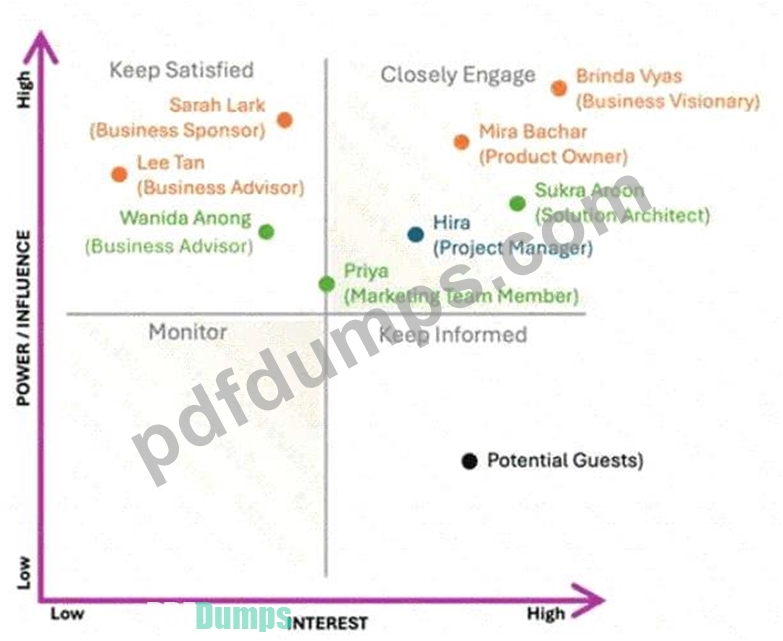
For each scenario in Column 1, select the MOST effective communication method from Column 2 to ensure successful outcomes and minimize risk of failure. Each selection in Column 2 can either be used once only or not at all.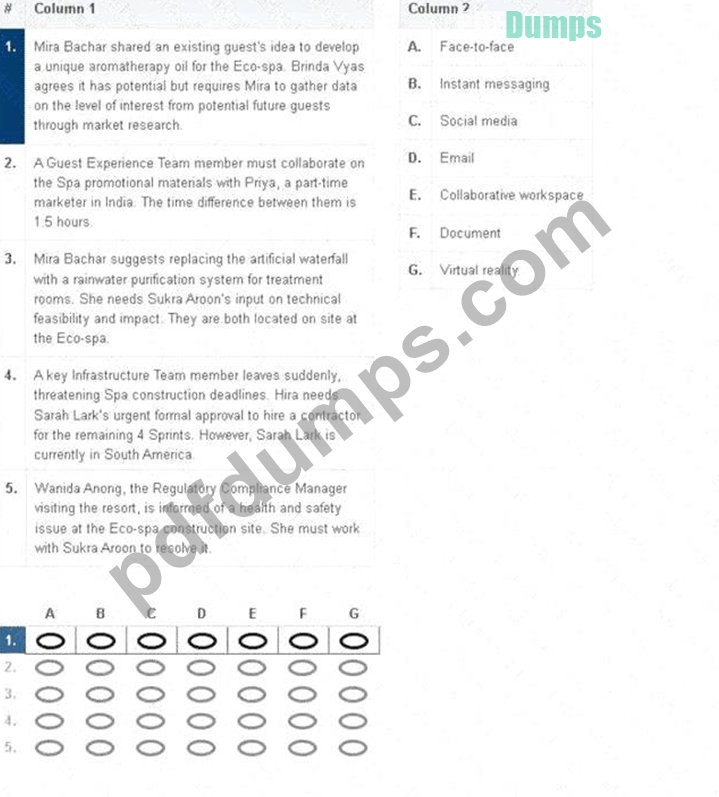
Answer:
Explanation: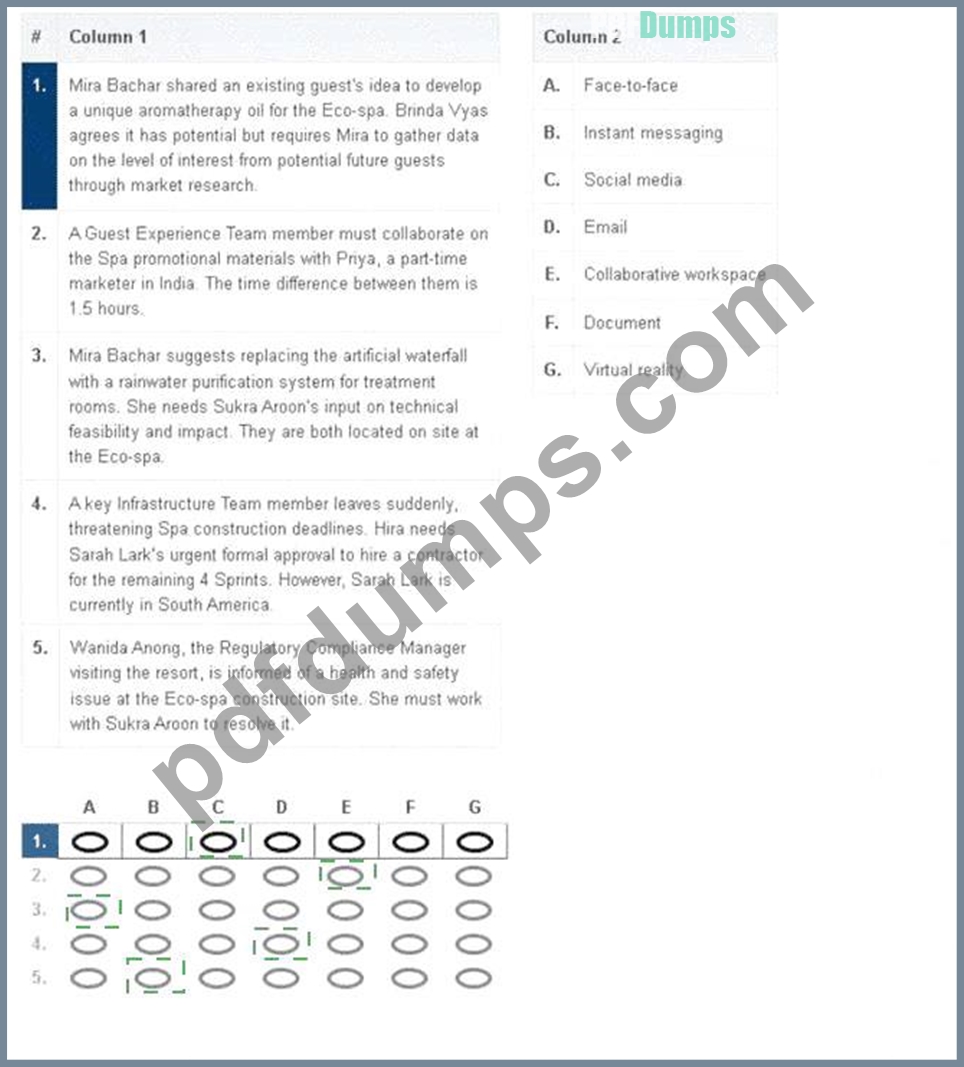
Explanation:
The best matching is:
1 # C (Social media)
2 # E (Collaborative workspace)
3 # A (Face-to-face)
4 # D (Email)
5 # B (Instant messaging)
Now the AgilePM reasoning for each:
1. Mira wants to gather interest from potential future guests for a unique aromatherapy oil Best answer: C. Social media This is the most effective option because the audience is potential future guests , who are external stakeholders with relatively low power but useful market influence. Brinda wants market research on likely interest, so the communication method should reach a broad audience efficiently and allow feedback collection at scale.
Why this fits AgilePM:
* AgilePM values timely feedback from stakeholders and users .
* Social media is highly suitable for testing interest, gathering reactions, and validating assumptions quickly.
* It helps support business value decisions before investing further.
Why others are weaker:
* Face-to-face is too limited in reach.
* Email is too narrow and inefficient for market testing.
* Document or collaborative workspace are internal tools, not ideal for external mass engagement.
2. A Guest Experience Team member must collaborate with Priya in India on promotional materials Best answer: E. Collaborative workspace This is the best method because the task involves co-creating content , likely with revisions, comments, versions, and shared visibility across time zones. Since Priya is part-time and there is a 1.5-hour time difference , a collaborative workspace supports both synchronous and asynchronous work.
Why this fits AgilePM:
* AgilePM encourages effective collaboration and visibility of work .
* A collaborative workspace allows both people to:
* edit shared materials,
* review updates,
* track changes,
* reduce version confusion,
* and keep progress transparent.
Why not email:
* Email creates fragmented threads and version-control issues.
* It is not the best tool for iterative collaboration on shared promotional assets.
3. Mira needs Sukra's input on replacing the waterfall with a rainwater purification system; both are on site Best answer: A. Face-to-face This is the strongest choice because the discussion involves technical feasibility, impact, and likely trade- offs , and both people are physically present at the Eco-spa. A face-to-face discussion gives the richest communication and allows rapid clarification.
Why this fits AgilePM:
* AgilePM favors direct communication where possible , especially for complex or potentially ambiguous topics.
* Technical and business conversations benefit from immediate back-and-forth discussion.
* Being on site means they may also inspect the actual area together, which reduces misunderstanding.
Why others are weaker:
* Instant messaging is less rich for a nuanced design/feasibility discussion.
* Email is too slow and formal for a collaborative on-site decision.
* Documenting the outcome may happen later, but the most effective method for the discussion itself is face-to-face.
4. Hira needs Sarah's urgent formal approval to hire a contractor; Sarah is in South America Best answer: D. Email This is the best answer because the communication need is both urgent and formal . Sarah is remote, and Hira needs a clear, traceable approval for hiring a contractor for the next four Sprints.
Why this fits AgilePM:
* AgilePM values communication that is fit for purpose .
* Since this is a sponsor decision with governance and approval implications, email provides:
* a formal record,
* clear wording,
* accountability,
* and easy reference later.
Why not instant messaging:
* Instant messaging may be faster, but it is less suitable for formal approval that may need auditability and clarity.
* For sponsor-level decisions affecting budget/resources, traceability matters.
5. Wanida identifies a health and safety issue on site and must work with Sukra to resolve it Best answer: B. Instant messaging This is the most effective option because the issue is urgent, operational, and time-sensitive . Even if both are on or around the resort, instant messaging enables rapid contact, immediate coordination, and quick sharing of updates while they move between locations.
Why this fits AgilePM:
* AgilePM supports fast, responsive communication when risks or blockers emerge.
* A health and safety issue requires quick coordination to minimize impact and prevent escalation.
* Instant messaging is practical for immediate action, especially on an active site.
Why not face-to-face here:
* Face-to-face is rich, but in this matching set it is better used for the complex solution discussion in scenario 3.
* For scenario 5, the key need is speed of coordination around an urgent site issue.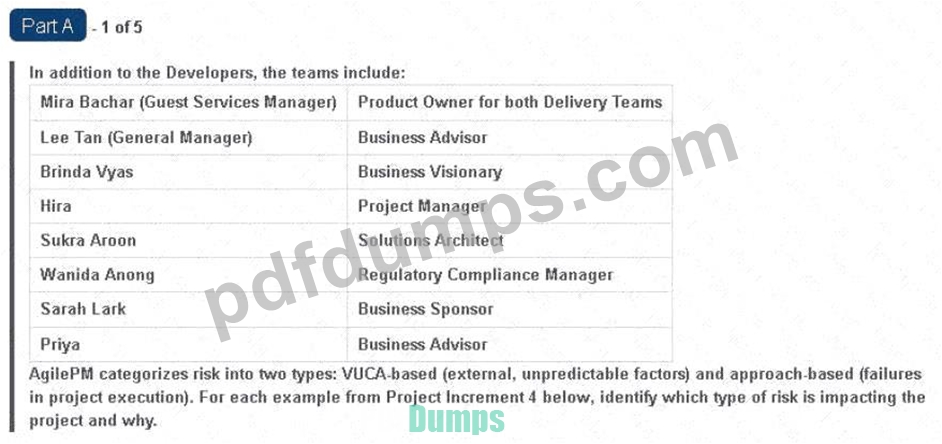
NEW QUESTION # 88
Xan Insurance Company is a friendly company with no separate private offices for individual managers. Staff members prefer to wander around the office space and have one-to-one chats rather than use email or have lots of meetings.
What action should the Project Manager take when planning for effective communication throughout the Web project?
- A. Identify those individuals with power and influence over the project and what information they require.
- B. As this is already common practice, assume all Solution Development Team members have effective communication skills.
- C. Mandate the use of email so that all communications are recorded for future reference.
- D. No action is required as the existing form of spontaneous informal communication is suitable for all project level and Solution Development Team members.
Answer: A
Explanation:
The most effective action the Project Manager should take to ensure effective communication throughout the Web project at Xan Insurance Company is:
A: Identify those individuals with power and influence over the project and what information they require.
In any project, especially within an Agile framework, understanding the stakeholders' landscape is crucial for effective communication management. Identifying key individuals with power and influence over the project helps tailor communication strategies to ensure that critical information is shared appropriately, decisions are facilitated efficiently, and stakeholder engagement is maintained. While the company's culture of informal communication can be advantageous for day-to-day interactions, structured communication is essential for project governance, risk management, and decision-making processes. This approach allows the Project Manager to ensure that all stakeholders are kept informed according to their needs and the project's requirements, balancing the informal communication culture with the need for formal communication where necessary.
NEW QUESTION # 89
To ensure that the UniCo change programme is successful, the Chief Executive Officer (CEO) knows that correctly assigning the key change roles will be essential.
Which 2 Sales Team Leaders (TL) are likely to be the line leaders MOST engaged in implementing change, based on the actions that have occurred to date?
- A. The South Region TL, who has continued to advocate that sales of Large Systems remain UniCo's priority.
- B. The Large Systems TL, who, due to their area's complexity, is scheduled to become involved later in the programme.
- C. The North Region TL, who has raised concerns about the change approach and whose feedback has been applied.
- D. The Sales Reporting TL, who has been allowed to see the confidential figures used to justify the Selco acquisition.
- E. The Finance Systems TL, who sent a team member to replace them in early meetings of the change programme.
Answer: C,D
Explanation:
Comprehensive and Detailed Step-by-Step Explanation
Selecting the most engaged line leaders requires identifying those who are actively participating in or contributing to the change program. The actions taken by the Sales Team Leaders (TLs) reveal their level of involvement, commitment, and influence in the implementation of the change initiative.
1. Why A (Sales Reporting TL) is Correct
* Access to confidential figures used to justify the Selco acquisition demonstrates trust and engagement in the program.
* This involvement indicates that the Sales Reporting TL is both informed and influential in driving the change initiative forward.
2. Why E (North Region TL) is Correct
* By raising concerns about the change approach and seeing their feedback applied, the North Region TL has demonstrated active engagement in the process.
* Their concerns and subsequent actions show they are not only participating but also influencing the direction of the change initiative, making them a key contributor.
3. Analysis of Incorrect Options
* Option B (Large Systems TL):
* Being scheduled to become involved later suggests that they are not currently engaged in the implementation of the program.
* Eliminate.
* Option C (Finance Systems TL):
* Delegating responsibility to a team member indicates a lack of direct engagement in the change program. A key change leader should be actively involved, not represented by others.
* Eliminate.
* Option D (South Region TL):
* Advocating for maintaining a focus on Large Systems indicates resistance to the new direction, which is centered around mobile applications. This lack of alignment with the change goals makes them less suitable as a key change leader.
* Eliminate.
4. Practical Implications
* Engaged leaders like the Sales Reporting TL (A) and the North Region TL (E) can act as role models and advocates for the change program, ensuring alignment and addressing resistance within their teams.
* Their actions demonstrate a balance of participation, influence, and commitment, which is essential for driving the change initiative successfully.
NEW QUESTION # 90
Answer the following question about different language style preferences identified by Pashler et. al. using VARK preferences.
As part of the Capability and skills development workstream, the Human
Resources (HR) Manager is considering the training needs of staff
managers undertaking staff appraisals. The HR Manager is designing the
learning activities so that they will appeal to differing ways for receiving and processing information.
Column 1 is a list of learning activities that could be used to develop the staff.
For each learning activity in Column 1, select from Column 2 the VARK
preference to which it relates. Each selection from Column 2 can be used once, more than once or not at all.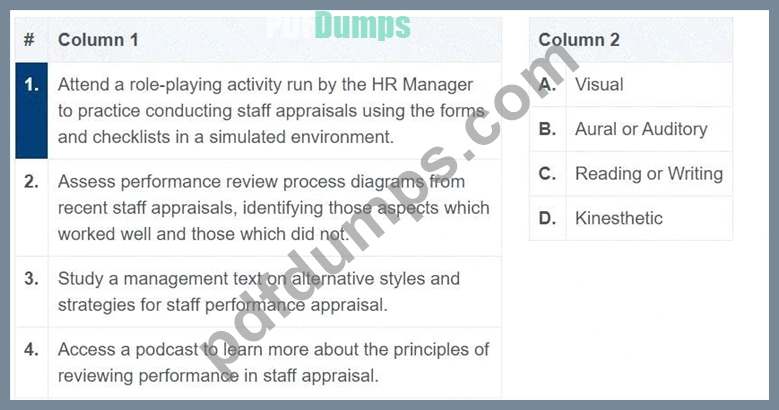
Answer:
Explanation: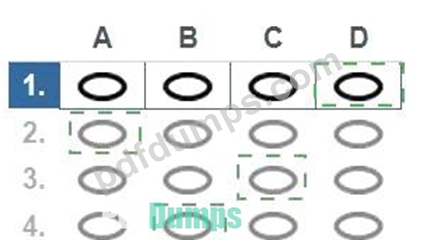
Explanation:
Answer the following question about different language style preferences identified by Pashler et. al.
using VARK preferences.
1. Attend a role-playing activity run by the HR Manager to practice conducting staff appraisals using the forms and checklists in a simulated environment.
* Answer: D (Kinesthetic)Kinesthetic learners prefer hands-on, practical activities. Role-playing simulates real-life scenarios, enabling learning by doing, which appeals to this preference.
2. Assess performance review process diagrams from recent staff appraisals, identifying those aspects which worked well and those which did not.
* Answer: A (Visual)Visual learners thrive on diagrams, charts, and graphical representations.
Reviewing performance review diagrams aligns perfectly with the visual preference.
3. Study a management text on alternative styles and strategies for staff performance appraisal.
* Answer: C (Reading or Writing)This activity suits individuals who process information best through reading and writing. It involves textual analysis, making it a clear match.
4. Access a podcast to learn more about the principles of reviewing performance in staff appraisal.
* Answer: B (Aural or Auditory)Podcasts provide auditory learning experiences. For learners with an auditory preference, listening to discussions and explanations is ideal.
Comprehensive and Detailed Step-by-Step Explanation:
* Role-playing activity (Kinesthetic): The activity involves movement, interaction, and application in a simulated setup, which matches the hands-on approach kinesthetic learners prefer.
* Performance review diagrams (Visual): Visual learners engage with content presented in diagrams or charts as these offer clarity through graphical representation.
* Management text (Reading/Writing): The reliance on written material, such as texts, articles, or reports, is a strong indicator of the reading/writing preference.
* Podcast (Aural/Auditory): Listening to content, such as in a podcast, aligns with auditory learning preferences, allowing learners to absorb spoken information effectively.
NEW QUESTION # 91
Which item is MOST likely to be considered as a pain point for a 'Sales team member' stakeholder?
- A. Increased effort will be needed initially to learn the new supporting business processes.
- B. Comprehensive training is required to broaden skills, that are recognized as best practice.
- C. This gives an opportunity for all staff to be involved and engaged in shaping the change.
- D. Rebranding gives the company a modern look that has been missing historically.
Answer: A
Explanation:
Comprehensive and Detailed Step-by-Step Explanation
Understanding Stakeholder Pain Points in the UniCo Scenario
A "pain point" refers to challenges, concerns, or additional efforts that stakeholders perceive during a change process. For the Sales team members, these challenges would most likely relate to adapting to new processes and requirements resulting from the rebranding and strategic shift.
Option Analysis
* A. Rebranding gives the company a modern look that has been missing historically
* This statement highlights a positive aspect of the change rather than a "pain point." While rebranding may indirectly impact the Sales team, it is unlikely to be perceived as a primary concern or challenge.
* Incorrect.
* B. Comprehensive training is required to broaden skills, that are recognized as best practice
* While training is an important component of change, the statement frames it positively (broadening skills recognized as best practices). Training may be challenging, but it is not likely the most significant pain point for Sales team members in this scenario.
* Incorrect.
* C. Increased effort will be needed initially to learn the new supporting business processes
* The UniCo scenario indicates that Sales team members are already facing disruptions to their normal processes. Learning and adapting to new supporting business processes (e.g., systems and practices introduced to align with Selco's expertise) requires significant effort and is a clear "pain point." This aligns directly with the operational challenges described for the Sales staff.
* Correct.
* D. This gives an opportunity for all staff to be involved and engaged in shaping the change
* Similar to A, this option reflects a positive engagement opportunity rather than a pain point.
While involvement in shaping change is beneficial, it does not directly address the challenges faced by Sales team members.
* Incorrect.
Why C is the Correct Answer (Scenario Alignment)
The Sales staff at UniCo are already facing disruptions and challenges due to the rebranding and integration of Selco. Adapting to new business processes, particularly those supporting mobile applications and innovation, represents a pain point as it demands additional effort and adjustment during the change process.
References (UniCo Scenario and AgilePM Alignment):
* UniCo Scenario: "Sales staff have faced disruption due to changes in sales processes and must adapt to new supporting processes."
* AgilePM Handbook, Chapter 8: Addressing Stakeholder Needs and Managing Change Impacts.
* Agile Business Consortium - Stakeholder Pain Points and Impact Assessment.
NEW QUESTION # 92
The Customer Services Manager used to work in a call center, answering customer calls. Concerned for staff wellness, this manager has decided to invite anyone who is finding the changes overwhelming to contact them directly so that they can arrange appropriate support.
Which preference does this behavior BEST display?
- A. iNtuiting.
- B. Feeling.
- C. Thinking.
- D. Sensing.
Answer: B
Explanation:
Comprehensive and Detailed Explanation:
This question uses the Myers-Briggs Type Indicator (MBTI) framework. The described behavior reflects a Feeling preference, as the Customer Services Manager is focused on the emotional well-being of their team and is acting out of concern for others' experiences.
1. Why the Answer is Feeling (D):
* People with the Feeling preference prioritize values, empathy, and the impact of decisions on others.
* The Customer Services Manager is actively addressing staff wellness by:
* Offering direct support to those who are overwhelmed.
* Focusing on creating a safe and supportive environment.
* This focus on emotional care and interpersonal connection aligns with the Feeling preference.
2. Analysis of Other Options:
* Option A: Sensing
* The Sensing preference involves focusing on concrete details and practical information. While the manager's previous experience in a call center may reflect this, their current focus on emotional support indicates a Feeling preference rather than Sensing.
* Eliminate.
* Option B: iNtuiting
* Intuition focuses on abstract ideas, possibilities, and long-term vision. While Intuition could play a role in managing change, the behavior described is more centered on immediate emotional needs rather than abstract concepts.
* Eliminate.
* Option C: Thinking
* The Thinking preference involves making decisions based on logic and objective criteria. While Thinking is important in management, this scenario focuses on empathy and emotional care rather than logical analysis.
* Eliminate.
3. Practical Example of Feeling Behavior:
* A manager with a Feeling preference might offer counseling services, check in on staff morale, or prioritize team harmony during periods of organizational change. This aligns with the Customer Services Manager's actions to support overwhelmed team members.
4. Reference to MBTI:
* Feeling (F):
* Makes decisions based on personal values and empathy.
* Focuses on harmony, emotional well-being, and understanding others' perspectives.
* Thinking (T):
* Makes decisions based on logic and objective analysis.
NEW QUESTION # 93
Answer the following questions about the acceptance criteria within the project.
Decide whether the approach to setting and using acceptance criteria has been applied appropriately and select the response that supports your decision.
During Solution Development Timebox A, a new Health and Safety requirement arises: the front door is required to have wheelchair access. This is a legal requirement and is a Must Have before any staff or general public access can be allowed. The Solution Development Team will work with the Local Planning Authority Officer, the specialist who identified the requirement, to identify further acceptance criteria for Solution Development Timebox A.
Is this an appropriate action related to acceptance criteria?
- A. Yes, because the new requirement needs to be understood, built and delivered in this Timebox.
- B. No, because the Business Visionary is responsible for defining acceptance criteria.
- C. No, because this new requirement would NOT be included in the original Prioritised Requirements List and therefore does NOT need acceptance criteria to be defined.
- D. Yes, because the Local Planning Authority Officer owns the justification for the new requirement.
Answer: A
Explanation:
A: Yes, because the new requirement needs to be understood, built and delivered in this Timebox.
Rationale:
Agile Project Management is adaptable to changes, even late in the development process. The introduction of a new Health and Safety requirement, such as wheelchair access, which is a legal and must-have requirement, needs to be incorporated into the project as soon as it is identified. Working with the Local Planning Authority Officer to define acceptance criteria ensures that the requirement is clearly understood and that the solution developed meets the necessary legal standards. This approach ensures that the team can immediately address the new requirement and integrate it into the current work cycle, aligning with Agile's principle of welcoming changing requirements, even late in development, for the customer's competitive advantage.
Topic 1, Hoy Hall Hotel Refurbishment Project
Scenario:
Hoy Hall Hotel Refurbishment Project
(Note:
Hoy Hall, a historic, timber-framed building dating from the 17th century, was originally the residence of the Lords of the Manor of Hoytown. The building is registered as a Heritage Building of Special Interest and is subject to restrictions in terms of development. Used as a hotel for over a century, it has recently fallen into disrepair, and for two years it has been completely unused, accelerating its deterioration. The local community has formed the Action Group "Hoy for Hoy Hall" to save the building, and wants to be closely involved in its future success.
After much discussion Hoy Hall has been purchased by Architecture Angels (AA), a small company whose directors are experienced hoteliers. Five years ago they decided to move into the property renovation business and have recently restored two other similarly-endangered buildings for use as hotels.
Architecture Angels are keen to both support local businesses and to have local people run their hotels, giving them a significant amount of autonomy to do this.
To maintain core consistency, the hotels use Architecture Angels' Head Office services, such as IT operations, accounting, payroll, stocktaking, compliance, human resources and property management. The Head Office is based 80 miles from Hoy Hall.
Recently Architecture Angels commenced an Agile project to renovate Hoy Hall, which has a large downstairs hall and reception area, and 20 potential bedrooms upstairs. The roof requires extensive repairs and the electrical and plumbing installations require complete replacement. The 40 acres of land around the site are overgrown and need to be restored, and the driveway needs re-laying.
In the hotel industry, the trend for direct customer bookings via the internet has had a major impact on the growth of those hotels with this facility. Online booking now accounts for around 80% of room bookings, with only 20% being made via walk-in and telephone enquiries. Before Hoy Hall can open for business, a reservation system must be fully operational.
Architecture Angels use contractors to manage such work and have good
relationships with two local companies: Timber Tigers (TT) who will handle the internal works, and Earth Excavations (EE) who will handle the gardens.
A Project Manager, who has since left the company, started the Feasibility phase. This phase has been continued by the Senior Management Team, which consists of the Sales, Marketing, and Finance Directors and the Chief Executive.
This was scheduled to take a month and has almost been completed. A
Feasibility Assessment has been produced. An Outline Business Case has been completed which assessed the project as being viable.
The Architecture Angels Senior Management Team will be responsible for
Steering the project.
The table below shows the appointments planned for the project team and is subject to change.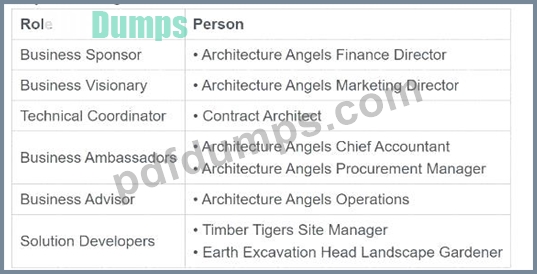
Additional Information:
The project is approaching the end of Feasibility. The original Project Manager was involved in drafting a Delivery Plan for the project but not in the outline refurbishment options.
The Senior Management Team generated several options for the refurbishment.
All the options included a landscaping solution for the gardens and re-laying of the driveway, as the solution will not be acceptable without these. However, the best solution for the refurbishment is still under debate. The new Project Manager has suggested that a Feasibility Prototype could consist of paper-based drawings for each option. The "Hoy for Hoy Hall" Action Group thinks that a physically-built representation is mandatory for a prototype and wants a small-scale model of the recommendation for the building. The time available to produce this, however, is limited.
Contracts for resources have not yet been signed and will be postponed until the chosen outline solution has been agreed.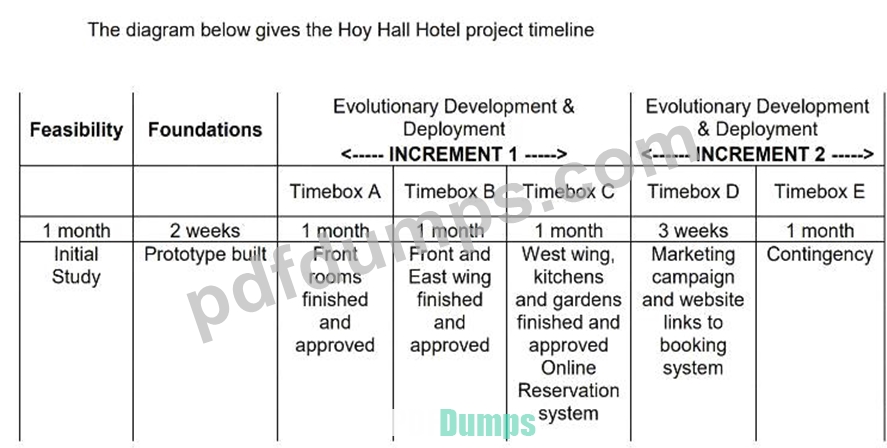
NEW QUESTION # 94
Which approach is the MOST likely to ensure that the participants apply themselves productively to the co-design tasks in a workshop?
- A. Work through items without any limitations on the solution.
- B. Place a time-limited focus onto the delivery of the workshop ' s outputs.
- C. Establish and discuss basic principles for interaction at the start of the workshop.
- D. Postpone discussion on practical changes until after the workshop has finished.
Answer: C
Explanation:
Comprehensive and Detailed Step-by-Step Explanation:
Facilitating a productive workshop requires careful planning and management of participant interaction and focus. Option D is the most effective approach because it sets the tone for collaboration and alignment early in the workshop.
1. Importance of Establishing Principles for Interaction:
* Establishing basic principles for interaction ensures that participants understand the expectations, goals, and structure of the workshop.
* It helps create a positive environment where participants are encouraged to collaborate, contribute ideas freely, and stay on track.
* This aligns with AgilePM principles, which stress the importance of clear communication, collaboration, and shared understanding.
2. Analysis of the Options:
* Option A: Work through items without any limitations on the solution
* Allowing unlimited exploration may lead to unproductive discussions, scope creep, or a lack of focus. Agile workshops require time-boxing and prioritization to maintain direction and ensure results.
* Option B: Postpone discussion on practical changes until after the workshop has finished
* Deferring discussions on practical implementation undermines the purpose of the workshop, which is to co-design actionable solutions. Agile encourages iterative discussions and addressing practicalities in real-time.
* Option C: Place a time-limited focus onto the delivery of the workshop ' s outputs
* While time-limiting focus is a good practice, this option overlooks the critical role of setting expectations and fostering collaboration. Without clear principles for interaction, time limits alone may not lead to productive outcomes.
* Option D: Establish and discuss basic principles for interaction at the start of the workshop (Correct Answer)
* Setting ground rules ensures participants remain aligned with the goals and are motivated to contribute productively. It minimizes potential conflicts, distractions, and misaligned expectations, fostering a collaborative atmosphere.
3. Application in UniCo's Scenario:
* In the UniCo case, where integration and cultural shifts are key, establishing principles such as respect for diverse viewpoints (Selco vs. UniCo staff) and focusing on actionable outputs would encourage productive discussions.
* Discussing principles ensures buy-in from participants and helps reduce resistance to change.
4. Agile Practitioner Documentation References:
* Workshops in AgilePM: AgilePM emphasizes creating structured workshops with defined roles, expectations, and interaction principles to maximize productivity.
* Agile Values - Individuals and Interactions: Clear guidelines for collaboration are foundational to achieving meaningful results in workshops.
* Facilitation Techniques: Best practices include setting principles such as time-boxing, respecting all inputs, and focusing on actionable outputs.
References:
Agile Project Management Handbook, Chapter 7: Facilitation and Workshop Best Practices Agile Manifesto Principle: Individuals and Interactions Over Processes and Tools Agile Facilitation Guidelines: Establishing Ground Rules for Effective Workshops
NEW QUESTION # 95
......
AgilePM-Practitioner [Aug-2026] Newly Released] Exam Questions For You To Pass: https://www.pdfdumps.com/AgilePM-Practitioner-valid-exam.html
AgilePM-Practitioner Answers AgilePM-Practitioner Free Demo Are Based On The Real Exam: https://drive.google.com/open?id=1i7gIruz4r-1-hsNA5fIue5r-0423L68h